Search This Blog

Showing posts with label nutrition. Show all posts

Monday, April 6, 2015

Is High-Fructose Corn Syrup Worse Than Sugar?!


High fructose corn syrup is a major ingredient in soda
High fructose corn syrup. It’s pretty much everywhere – breakfast cereal, soda, Spaghettios. It’s become the go-to substitute for sugar and as such, gets a lot of criticism. But, what exactly is HFCS and is it really worse for our bodies than sugar?
A video by the American Chemical Society set out to explore that question in-depth and the results will surprise you.
The process by which HFCS is developed seems pretty straightforward, however there is chemistry involved so don’t try this at home! Corn, the starting product, is broken down into corn starch and then further broken down to corn syrup. This syrup is finally sweetened by tweaking the proportions of fructose and glucose to yield the end product of high-fructose corn syrup.  

Corn à Corn Starch à Corn Syrup + glucose + fructose = High Fructose Corn Syrup
In reality, real sugar is very similar in composition to HFCS because both are made up of fructose and glucose. The video explains, “High fructose corn syrup comes in different concentrations for different products, but it’s remarkably similar to sugar.” And, most importantly, “the scientific consensus is that there’s almost no nutritional difference between the two."

To be clear, I’m not saying that you should now go out and consume soda by the gallons and candy by the pound but only that you should be just as concerned about HFCS as you are about sugar. Basically, consume sweets in moderation and try to fill your diet with lean meats, veggies, fruits, whole grains and dairy. The big takeaway is to put a cap on your overall sweets intake and substitute healthier choices like fruit or yogurt for a bag of Twizzlers or a soda.

Happy Friday!
Buzzard

Wednesday, February 18, 2015

Common Food Myths Exposed!

Readers,

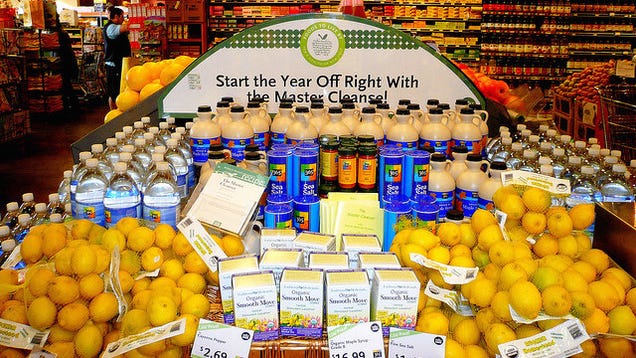
Every so often, you hear about the newest diet trend...one year it is Atkins, the next it is the Paleo diet. Or the experts will try to tell you that you need to 'cleanse' and 'detox' to get all of the harmful toxins out of your body.
What Happens in Your Body During a "Cleanse" or "Detox"

We all know that most of these diets, including veganism and vegetarianism, have some purported benefits, and that they also come with sacrifices. Simultaneously, I think that we all know that half of it goes back to someone trying to push an idea or sell a product so that they can make a dollar off of someone else. It's no different than the next clothing trend, designers and fashion-experts going to extremes to make a new look in vogue...it helps them sell more items as consumers have to change their wardrobe to fit in to popular culture. We all participate in it, and we're all victims of these marketing efforts.

So as long as we are on the same page and can be honest with ourselves, I think it is fair to remind everyone of some 'food myths' that many of us believe that have since been disproven. Some of these were quite surprising to me as well! While I'm going to focus on the highlights, feel free to check out the original source at ViralNova.


Myth: Chicken skin is bad for you.
Myth #1: Chicken skin is bad for you
     Seriously though, who hasn't seen someone who peels the delicious skin off a chicken breast because of this myth? I don't, but I inwardly think to myself that I probably shouldn't eat it. In fact, the breading on a piece of chicken soaks up a lot more oil than the skin has itself. We always think chicken skin is bad for us because it is greasy and delicious, but from a nutrient standpoint, over 55% of the fat in chicken skin is the heart-healthy kind: mono-unsaturated fat.
 
Myth: Avoid whole milk.
Myth #2: Avoid whole milk
Well, no one can argue that this is still a very active food myth, judging by the aisles of 1%, 2% and skim milk at the grocery store. The funny thing is, there is peer-reviewed scientific evidence showing that if you drink whole milk, you are at a lower risk for heart disease!
 
                             Myth: Sea salt is healthier than regular salt.
Myth #3: Sea salt is better for you than regular salt
Sodium chloride is the elemental name for table salt. Do you know what the elemental name is for sea salt? Oh yea, it is also sodium chloride! While it may be processed differently, sea salt still contains the same amount of sodium, which everyone is trying to regulate their intake of, despite shaky scientific evidence on that front as well.
Myth: Gluten-free living will benefit everyone.
Myth #4: Gluten-free living will benefit everyone
For the 1 in 133 people who suffer from celiac disease, consuming gluten is not in your best interest. But for everyone else out there, going gluten-free really won't accomplish much from a nutrition standpoint. Check out this review paper on whether non-celiac gluten sensitivity even exists.
 
 
Myth #5: Avoid high-fructose corn syrup like your life depends on it
There has recently been quite a stir about the superiority of table sugar versus high fructose corn syrup (HFCS). While critics point out that it's not a natural form of sugar, the inclusion of HFCS in nearly everything helps keep food prices low and is deemed "safe" by the US Food and Drug Administration. In comparison, table sugar is 50% fructose and 50 percent glucose, so HFCS only contains 10% more fructose than regular sugar.
 
I suppose the big takeaway for me is don't believe everything you hear about one food being the root of all of our country's problems around obesity. If you can't get through the day without drinking six or seven cans of soda, then you are probably getting way too many calories from soda, whether it is sweetened with HFCS or table sugar. Don't be duped simply by clever marketing and sales campaigns to make you pay a premium for a product that may not have any real nutritional benefit.
 
As with most things in life, moderation goes a long way. If you complement a moderate amount of protein, carbohydrates, fats, and sugars with a healthy lifestyle and regular exercise, you're probably going stay relatively fit and healthy.
 
I hope you enjoyed the reading, and this is just the tip of the iceberg! If you want to fact check on some other 'food myths' including MSG, the real nutritional content of potato skins, and whether carrots improve your eyesight, don't forget to check out the details at ViralNova!
 
 
Cheers,
 
Hyatt Frobose



Sunday, June 2, 2013

Superfood: Flax Seed


Flax Seed: Up close and personal.
You may find flax seed in your local grocery store, check in the cereal or supplement aisle. It's considered a superfood, a fad term given to food products that are high in a nutrient content that is believed to be a health benefit.

What ingredient is so SUPER in this oily seed? Omega-3 fatty acids.

Jim Drouillard, a professor at K-State, has been researching flax seed for the last decade. Not in human nutrition, but ruminant. Ruminants are mammals that digest plant-based food because they have bacteria and protozoa in their digestive tract that can help them out! There are about 150 species of ruminants, but Dr. Drouillard is interested in cattle.

He has found that feeding flax seed to cattle in the five months before they are ready to be slaughtered can help make these animals more healthy. He set out to improve the health of the animals, but also found that it increases the amount of omega-3 fatty acids found in the meat from the animals fed flax seed.

NBO3 Technologies is a Kansas-based company that launched a ground beef product that is high in omega-3 fatty acids. Flax seed is pretty expensive, but for consumers who are willing to pay for the higher priced beef product, it's a good option.   

It also goes to show that the research done at Universities like Kansas State, is groundbreaking and necessary for advancement in today's society.


Always a Wildcat,

Tera 

Monday, August 27, 2012

Does America Need a Fat Tax?

Dedicated readers,

Have any of you ever heard talk about state or federal governments putting in place a "fat tax"?

Our country has become the poster child for obesity in the modern world. While there are still around 1 billion people in the world that go to bed hungry, the USA and some other 1st world countries (I'm talking about you Australia and England!) are facing an obesity epidemic where, according to the 2010 WHO report, over 68% of the adult population is overweight and 34% are obese.

So.....what actions do we take to right the ship?

Some might argue that it is each person's own responsibility to maintain their health by eating better and exercising regularly. I think this is a logical thought process and everyone should be able to show a little restraint at the local all-you-can-eat $9.99 dinner buffet, or at least run a couple miles the next day to work it off.

However, some people have taken a different approach to possibly curtailing our intake of fatty, sugary and generally unhealthy foods. They argue that humans are unable to restrain themselves from eating the cheap, convenient, and often unhealthy foods that on-the-go Americans find themselves indulging in way too often. From a scientist's perspective, I find myself agreeing more and more with this argument because we are innately programmed through our sensory systems to prefer the foods that are more calorie-dense. To add even more credence to this, a 2002 study by Horgen and Brownell in the Journal of Health Psychology indicates that eating behavior may be more responsive to price increases than nutritional education.

Apart from the possible reduction in intake of unhealthy foods and drinks, a fat tax does offer some additional advantages. The tax revenue could be used to offset medical costs generated by obesity-linked health conditions, to improve nutrition education and to incentivize physical activity.

There are also many arguments against a fat tax. As a supporter of small government, I can appreciate those that don't want Big Brother involved in our food choices and telling us what we can and cannot eat. One of the most compelling arguments against is that a fat tax would be regressive, disproportionately affecting the poor. The poor typically rely more heavily on cheaper foodstuffs (typically those that are more highly processed and unhealthy such as fast food), and therefore some argue that a fat tax would be the equivalent of a tax on the poor.

One idea that I've had is that if we tax unhealthy foods, could we use the tax revenue as a way to subsidize healthy foods like fresh fruits, vegetables and lean meat so that food costs wouldn't increase as much?

The biggest hurdle regarding the implementation of a fat tax would be how to decide what foods and drinks would or wouldn't incur the tax. Perhaps we can wait and see what happens in Denmark, one of the only countries that has put a national tax on unhealthy foods.

If you have any input or thoughts on this topic, I would love to hear from you!

Thanks for reading,

Hyatt Frobose

Sunday, June 5, 2011

Want to boost your brainpower? Eat meat!


Or more specifically, beef.  Dr. Mike Moreno, author of The 17-Day Diet: A Doctor's Plan Redesigned for Rapid Results, created a list of must-have brain enhancing foods.  You can read the whole list and article online here.

Number one on the list was BEEF. Beef is high in iron, which improves memory, alertness and attention span. It's also a good source of zinc and protein. For more nutritional facts about beef and how to make it part of a healthy lifestyle check this out.

Other awesome proteins that made the Top 17 were:
#6 - Chicken - High in tyrosine - an amino acid essential for production of the substances epinephrine, norepinephrine and dopamine which are responsible for alertness.

#9 - Eggs - Boost memory through rich supplies of the B vitamin choline.

#10 - Egg whites - High in protein - help improve alertness and produce norepinephrine.

#13 - PorkBe inspired by pork's wealth of Vitamin B1 that helps facilitate communication among nerve cells.

#16 - Tuna -  Full of omega-3 fatty acids, which help build and maintain myelin that aid in communication among nerve cells.

I've got some more work to do on my thesis, so I think I'm going to load up a plate with beef, pork and chicken and settle in for a night of brainstorming.

Until next time,
~ Buzzard ~

LinkWithin

Related Posts with Thumbnails