
Search This Blog

Showing posts with label assistance. Show all posts

Tuesday, August 2, 2016

"Fair" Information

In today’s age, information is everything. From knowing exactly what ingredients are in our breakfast to being able to look up a definition in mere seconds thanks to our smartphones, we crave info. You may even be on this blog looking for info on how to properly prepare meat or how gluten affects your diet.  Today’s consumers are looking for the information about our food, and rightly so! However, when I searched the phrase, “What is in my food” nearly 67,900,000 results were pulled up by Google. Where on earth would I start?

Well, I have a solution. Instead of mindlessly scrolling through websites, step away from your computer and head to your local, county or state fair. We are in the midst of “Fair Season” as we speak. Around the country, fair exhibitors are working their hardest to earn that coveted blue ribbon with their assortment of projects. From the outside, it may seem like the fair is simply a place to ride the Ferris wheel and get delicious cotton candy, but if you’re looking for information about what is in your food, or where it comes from, this is exactly the place to find answers. 

Photo courtesy of Central Kansas Free Fair

The youth involved in 4-H and FFA are knowledgeable students who, when asked questions, will tell you the honest truth about their projects. The internet is a bundle of info, some of it scientifically correct, and some incorrect and opinionated; it can be difficult to draw the line. Having face-to-face conversations with these youth can show you the whole picture, the good and the bad. They work year-round to ensure that their projects will be fair-ready and have seen the ups and downs of the industries they serve.  

Not only can you get info from exhibitors, but you can see the process of farm-to-fork in real time. Head to the crops exhibit to learn about the variety of grains and grasses that make up our food supply. Stroll over to the livestock barns to inquire about how students care for their poultry, beef, pigs, sheep and goats. Then head to the baking exhibit to learn about what grains and other ingredients to use to make your apple pie blue ribbon worthy. In a country where the average consumer is 3 generations removed from traditional agriculture, this is the perfect opportunity to witness the process first hand. 
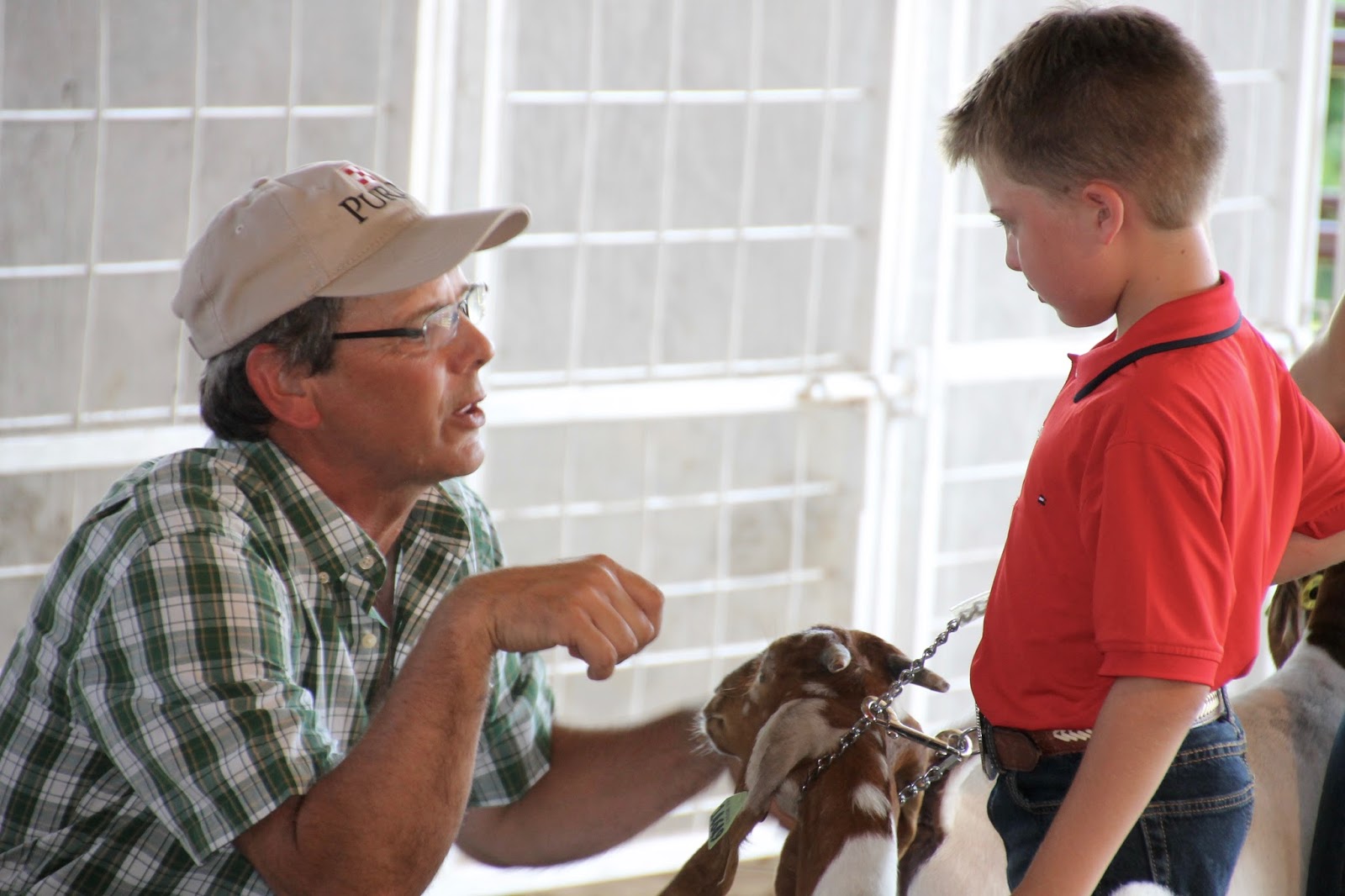
A junior goat exhibitor talking to the judge during showmanship.
Don’t forget the wonderful fair food and attractions, however, like the aforementioned cotton candy and Ferris wheel. If you’re looking for info about your food, put down your technology and head to the fair. Ask questions, witness the work of exhibitors, have fun, and learn about more about agriculture.

Your purple ribbon writer, 


Kyler

Monday, March 5, 2012

PETA Posts Shameful Euthanasia Rate

24
The number of pets that were lucky enough to be adopted out last year by PETA.

Another number for you to ponder: 95+ -- The percentage of pets in PETA's care which were euthanized in 2011 (1911 pets).

One more big number: 37 MILLION -- PETA's annual budget. Doesn't seem like they're short on cash for dog or cat food.

I'm not the only one who finds this abhorrent. An interested resident of Virginia (PETA's HQ is located in Alexandria, VA) called HQ and inquired as to whether or not there is an animal shelter at HQ. There isn't, shockingly (or not?).

Upon learning of this, Dr. Daniel Kovich, Director of Animal Welfare and Health Policy for the Virginia Department of Agriculture, conducted an investigation of the facilities and determined that the building doesn't have anywhere near the necessary amount of space for the animals it takes into custody. Additionally, Dr. Kovich found out that PETA euthanizes approximately 84% of the animals it takes in within 24 hours of receiving them into their facilities. That's shameful.

For the record, I acknowledge the fact that some animals are so horribly treated and abused that the most humane thing to do is euthanize them. This is of course, very sad but necessary, and I can appreciate PETA euthanizing those specific animals. However, in no way do I believe that 1911 pets were in such horrendous condition that they needed to be euthanized within 24 hours. I'm not buying it.

I didn't write this post to blaspheme PETA and make people aware of their outrageous actions - they're marketing department does a fine job of that on their own. I merely want to point out that your donated dollar to PETA doesn't necessarily go towards saving pets. Unless they're one of the lucky twenty-four.

If you really want to help, donate money or dog/cat food to your local animal shelter. Or, even better, adopt a pet from your local animal shelter rather than purchasing a purebred.

In closing, I want to leave you with one last fact. The Oregon Humane Society saved over 10,000 pets in 2009 through adoptions, owner reunions and transfers. Over 10,000 - in one state.

Until next time,

~ Buzzard ~


Thursday, September 22, 2011

USDA To Provide Hurricane Irene Assistance

You might remember hearing from our USDA guest blogger, Kevin, this summer. If not you can visit his last post here. Kevin is here again to inform us about what the USDA has a role in during times of natural disasters. The USDA (United States Department of Agriculture) executes federal policy for all things dealing with farming, agriculture and our food! Enjoy Kevin's post.

While Hurricane Irene hasn’t been as destructive as Katrina was, it still has left the East coast in shambles.  The storm is estimated to have caused $10 to $15 billion in damage, and footage of the affected areas quickly explains why.  Since many of the affected states haven’t encountered a hurricane in over 100 years, many were unprepared for this disaster. 

Crops were washed away, pastures flooded, and homes were destroyed by Irene - not to mention the equipment, livestock, and everything else to go along with them.  Hope is not lost, however, for the farms, ranches, and rural communities in the Northeast.  The USDA has recently indicated that it will be providing assistance to those in Presidentially deemed disaster areas.
“Our thoughts and prayers go out to all who have suffered losses caused by this massive storm,” said Agriculture Secretary, Tom Vilsack. “USDA is ready to provide food, emergency assistance and other resources to the affected areas. We continue to closely coordinate with many partners to meet the immediate and plan for the long-term needs of those affected by Hurricane Irene.”
The USDA is offering a wide variety of assistance to farmers and ranchers alike, and is beginning to distribute such aids. If your farm or ranch was damaged or destroyed during Hurricane Irene and the flooding that occurred afterward, you may just be eligible for assistance.  Types of aid that you may be able to secure include:

  • Community Assistance
  • Farmer and Rancher Assistance
  • Housing Assistance
  • Food Assistance
  • Business Assistance
  • Utility Assistance

If you have questions about any assistance that you may be eligible, call your local Rural Development office if your needs relate to housing, your business, or your community.  Homeowners can also contact a USDA loan specialist to determine their eligibility.  For reports of produce and livestock loss, contact your local USDA Farm Service Agency Service Center as they will be able to help you find the appropriate reparations.  If you have debris that you wish to be removed from your property that was brought on by Hurricane Irene, call your local Natural Resources Conservation Service office.

Kevin Pearia
USDA

LinkWithin

Related Posts with Thumbnails