Search This Blog

Showing posts with label global agriculture. Show all posts

Wednesday, February 24, 2016

Life on a French Swine Farm

This past July I had the opportunity to intern on a swine farm near Auvers-le-Hamon, France. During the month, I lived alongside the Huet family who was the most welcoming and generous family. The family included Alexis, the father, Domonique, the mother, their daughter Anais as well as their sons Esteban, Arthur and Antoine. Needless to say, this experience was one of the biggest learning experiences I have ever had. I was able to learn about French agriculture and observe the similarities/differences to American agriculture.

The house that I lived in with Esteban and Arthur in France
While on the farm, I worked mainly with the sows and their litters. My duties included assisting with farrowing, weaning of piglets, insemination, giving shots and vaccinations as needed, and maintaining the animal stalls among other tasks. The Huet’s operation was truly a family effort with family members working directly on the farm and others working to regionally market their product. The Huet’s utilized the Label Rouge, or red label, program when marketing their product.


 Products with the above seal on them are certified under the Label Rouge. This program guarantees that its products have met a specific set of characteristics establishing that is of higher quality to similar products. Food products and non-food agricultural products such as flowers are eligible for certification under this program. In all that translates to about 500 products being certified under this program in France. For pork, some of the criteria deal with feeding, breeding conditions and age at the time of slaughter.

The most challenging and rewarding part of the internship was working alongside people who spoke almost entirely no English while I spoke very poor French. At the start communication was a big obstacle to overcome when trying to accomplish basic farm tasks. After a few days, we were able to establish a routine and communicate effectively through body language and the few words of French and English that both parties knew. Even though I was not able to have a conversation with the workers, I could tell that they truly cared about their profession and raising their hogs in a healthy environment was their top priority. This showed me that no matter where you may find yourself that producers in both the U.S. and abroad care about the quality of products that they provide to consumers and make agriculture a unique industry due to that characteristic.

If you have any questions, comments or concerns send them my way. I would love to hear them!

Signing off,
Wyatt Pracht

Wednesday, October 8, 2014

Agriculture's Employment Problems


The topic of immigration has been a hot button over the past decade. The media has jumped on this conversation, or heated debate may be a better term to describe it, but they have ignored the dysfunction in the legal non-immigrant visa programs that the agriculture sector so heavily relies on. I have been exposed to the problem in the status-quo because my family is actively experiencing these problems.

2014 Harvest Crew: 5 H-2A visas & 9 J-1 visa  
My family has a farm and a custom harvesting operation (Frederick Harvesting) where we hire approximately 22 seasonal employees for 8 months of the year to help with the preparation of the harvest season and then be either a combine operator or truck driver for both the summer and fall seasons. Of the 22 seasonal employees about half of the crew is American and the other half is foreign. Our foreign employees are from countries you wouldn't normally think that the agricultural sector relies on; England, Ireland, Wales, Scotland, New Zealand, and Australia mainly. We hire these men their first year on a J-1 visa.  The J-1 visa is described as, "The Exchange Visitor (J) non-immigrant visa category is for individuals approved to participate in work-and study-based exchange visitor programs" according to http://j1visa.state.gov/basics/. After the workers come through this visa, if they loved their work and want to come back and work for us for the next season they must come back through the H-2A visa program. This is where the dysfunction happens.

The H-2A visa program is described by the U.S Citizen and Immigration Services as, "The H-2A program allows U.S. employers or U.S. agents who meet specific regulatory requirements to bring foreign nationals to the United States to fill temporary agricultural jobs." (http://www.uscis.gov/working-united-states/temporary-workers/h-2a-agricultural-workers/h-2a-temporary-agricultural-workers)

2010 crew: 3 H-2A visas, 8 J-1 visas
The root of the problem is that Americans don't want to hold these jobs and there is a line of young skilled foreigners that want these jobs. The H-2 visa program is a cycle of dysfunction and frustration for the employer and the foreign employee. The employee works and is trained on the job for 8 months, has to go to their home country for 4 months with uncertainty if they will even be accepted to the visa program for the next year. This makes for an uncertain and unstable labor force for the employer. When talking to my dad who deals with these problems hands on he said, "The program needs to be a more reliable system so that the employee and I don't have to play a waiting game." He went on to point out that these workers are legal and paying taxes in this country to work here. Something clearly must change.

The Ag sector is voicing that they want change. A logical fix that is being discussed in D.C. is to grant an H-2A visa for a 3-year period with the worker going home during the off season. Another one of the major changes that is being lobbied for is for the H-2A visa program is to include sheepherders and dairy workers. The dairy industry is running into the same problem; not enough American workers that want to do the job.


Karly Frederick
Ag-business Major

Thursday, November 8, 2012

ULS Secretary Rodman - Success!

Well, Secretary Rodman spoke about Kansas Agriculture in the year 2025 on Monday night and we are thrilled with the turnout - almost 250 people showed up to learn more about our state's most important industry. Thanks to all who attended and we hope you gained a better perspective of Kansas' role in global agriculture.

As previously announced, the hashtag #ULSRodman was the handle to follow and there were some great tweets by the audience. We've also included some pictures from the evening.


A great turnout for our guest, Secretary Rodman


Secertary Rodman addressed many important issues including water conservation, population and food interactions, future opportunities for young people in agriculture and the desire and capability for Kansas agriculture to expand and meet global food demand.

Thanks again for all who attended - we appreciate your support of agriculture, Food For Thought and bridging the gap!

Until next time,
~ Buzzard ~

Tuesday, February 7, 2012

I'm An Agronomist

So I'm not really an agronomist but that is the name of a website created by Iowa State University that is dedicated to agronomy education. I found the site while visiting a few friends in Ames, IA this past weekend who had an "I'm An Agronomist" magnet on their fridge. Good advertising, I think.

Anyway, here on Food For Thought, we strive to provide a window into all aspects of agriculture so today I thought an inside look at agronomy would be a change-up.

The motto of I'm An Agronomist is "applying science to fuel and feed our global society" - very catchy and very true. The website addresses issues like bio-energy development, how to confront world hunger and protecting human health. I'm pretty interested in feeding 9 billion people in 50 years so I clicked on the World Hunger link and was pleasantly surprised at the tactics agronomists are using to help solve our world hunger problems:

There are now 854 million undernourished people in our world 820 million in developing countries, 25 million in countries formerly controlled by the Soviet Union, and 9 million in industrialized countries. These numbers reflect the intersection of complex historical, economic and political problems that together have created chronic poverty. The companion to poverty is hunger fed by a lack of access to fertile land and resources to grow food, and /or a lack of sufficient opportunity to generate income to buy food.
The solution to hunger must start from the ground up especially since many of the worlds hungry also live in rural areas. Agronomists use skills and knowledge across the areas of soils, agroecology, climate, crop diversity, and plant breeding to help identify and analyze systemic problems facing the agriculture of an area. Contributing this training to the knowledge and practices of local farmers, in the context of their culture, could generate creative ideas that have the potential to take aim at one of the most unjust and unacceptable problems of our time. In this way, agronomists are, "confronters of world hunger"
I was also interested in the human health portion and after checking out that particular page I learned some nifty info on healthier soybean oils. I'm a supporter of fried chicken, chicken fried steak, fried potatoes, etc - so healthier oils to use while preparing those tasty dishes is relatively important to me.
Neat, huh? I also found a cool podcast link, YouTube videos from ISU's Agronomy Channel and if you're ready to bleed agronomy, red and gold --- several desktop wallpaper themes.

I enjoyed reading more about agronomy and the different technologies utilized in crop production, and I hope you'll give the I'm An Agronomist website a look.

Until next time,
~ Buzzard ~

Monday, January 30, 2012

Technology Has Brought Us A Long Way

I am not a very tech-savvy person. At all. I still don't know how to use Bluetooth and that's been around for about 8 years, maybe more? Anyway, just because I don't understand it doesn't mean I don't appreciate it. Technology has made it easier for parents to teach their children the ABC's at young ages, has improved health care, has globalized  industry and in general has improved our quality of life (although the occasional IT headache does occur). Additionally, technology has made agriculture immensely more productive over time.

What do I mean? Think about it - in the 60's and 70's Norman Borlaug and his associates created new varieties of corn, rice and wheat that vastly improved the amount of food farmers could produce. In some countries of the world, for example in East Africa, food intake went up by 50%. This was achievable with the application of technology.

In his annual letter, Bill Gates highlights these facts and others about the need for technology to feed our growing world. That's right, Bill Gates has gone agvocate. Well, not really but he does make a great case for our industry.

Bill points out that in the 19th century, the majority of the U.S. workforce was in agriculture. Today, less than 2% of people are responsible for all U.S. food production however, in countries like Uganda 75% of the citizens produce the food. U.S. farmers are so productive that the average family spends less than 10% (8.9% in 2009) of their annual income on food. That is a microscopic amount compared to a country like China who in 2009 spent 37% of their income on food.

It's also brought to attention that only $3 billion a year is spent researching the seven most important crops. This amount needs to increase for the sake of our productivity - especially as our climate continues to change which could cause a 25% decrease in the crop yield if we continue to see droughts and floods like this past year. Research into soil science and crop production can help us to be more efficient with our resources, which is especially important with climate change, urbanization and our growing world population. He suggests we need to increase that amount if we want to be able to meet the demand for food over the next 50 years

Before I close, I'd like to share this picture with you. A little Food For Thought, if you will (cliche, I know):

With this picture I'm not trying to say taxes are high, I'm pointing out the extreme affordability of our food supply. We are very blessed in the states to have such 'cheap' food that has been brought about through research, hard working farmers and technology.

Until next time,
~ Buzzard ~

To read Bill Gates full letter, click here. Photo credit from here

Monday, December 12, 2011

Don't Just Thank a Farmer, Thank a Shearer Too!

   Many of you won't know what I mean when I say shearer, but my experience here in Australia has made me very familiar with shearing. Australia is the world leader in wool production, and has been for over a century. There are over 72 million sheep in Australia compared to 23 million people, and the ironic thing is that sheep numbers are at their lowest since 1905. A big part of that is because of long years of drought, but also because the type of sheep has changed into a bigger sheep with more wool.
    Australian wool is generally regarded as some of the highest quality wool in the world, and the best of it comes from the Merino breed. Merino sheep have been bred for hundreds of years to produce extremely fine wool and have been selected to have wrinkly skin as this allows more surface area for wool to grow. A mature Merino ewe can produce over 15 pounds of wool per year, a pretty impressive feat considering wool doesn't weigh very much and they are usually only shorn once per year.
    The main point I wanted to drive home was the fact that although many other professions in agriculture have changed drastically in the past 100 years, sheep shearing is still largely the same. Although machine shears are used today, shearing is still a very physical, tiring job for shearers who are expected to shear on average 150 per day. As they are paid by the sheep, it is in their best interest to get them done as quickly as possible, but this is a job that is alot harder than it looks.

   One notable story involves Jackie Howe, the world-record holder for sheep shorn in a day, who sheared 321 sheep in 7 hours and 40 minutes! The scary thing is, he did this in 1892 with HAND shears, and his record hasn't been beaten to this day!

   Last week, I tried my hand at shearing a few Merino ewes. After getting a brief lesson on how to position the ewe and hold her so that I didn't hurt her and could still shear effectively, I had a go at it. While most shearers take 3-4 minutes per sheep, I was still going at 20 minutes and sweating like crazy! I had similar results on the second sheep I attempted, after which I looked at shearing completely differently. I swore that I would never take for granted the hard work that goes into shearing a ewe and I think it is important to recognize the hard-working sheep shearers out there in the world who are alot tougher than I am!

Thank a shearer next time you put on your wool scarf and coat!

Cheers,

Hyatt

Monday, June 6, 2011

Thrown Out With the Bathwater


I was astounded to see the figures of a new study released by the U.N. Food and Agriculture Organization (FAO) and the Swedish Institute for Food and Biotechnology (SIK); their findings suggest that 1/3 of the food produced in the world for human consumption is LOST or WASTED! Working to decrease this loss is definitely critical to the current and future stabilization of global food supply. Click Here to read more.

Tuesday, March 1, 2011

Feeding the Increasing Population

Today I listened to Dr. Luis Rodriguez, from the USDA Agriculture Research Service at Plum Island Animal Disease Center speak about the importance of a one health approach to foreign animal disease eradication.

One health is the focus of healthy animals, healthy people and a healthy environment. This is an important approach to creating a safer, more healthy world.

This graph was in Rodriguez's presentation and really drives home the point of what we are up against. The x-axis represents three-year time intervals over the past several decades. The y-axis represents per capita consumption of different food groups.


You will see that the per capita consumption of eggs, meat and milk are significantly higher than other food groups. Eggs are the cheapest protein source on the market and can be easily incorporated into countries with traditional agriculture practices being a family's main source of food.

We will have a larger population to feed in the future, and it clearly will not be a population of vegetarians. Food animal production will become even more important in the years to come. Foreign animal disease research is vital to production and Manhattan, KS will be a huge player in this research with the building of NBAF.

My Best,

Tera Rooney

Monday, February 14, 2011

What are your thoughts?


We want your food for thought! Go to this article on the NYtimes and give us your thoughts in the comment box below.

I created the picture above using Wordle and it eliminated the common, meaningless words from the article to get a big picture of the topic and a neat typography image.

Friday, October 29, 2010

Cotton is King [Part 2]

This is part two on my posts about cotton.

Now that we know a little bit more about cotton as a crop and fiber product, let's talk about cotton as food. Cotton as food? Like cotton candy?

Well, after reading my last post, nobody really believes that cotton candy is the same stuff grown in the fields. Let alone, would you argue that cotton candy could actually be considered food!

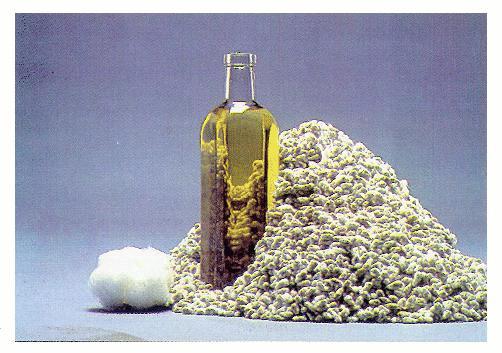
The cotton plant, besides producing a sustainable fiber because many alternatives to it require processing with non-renewable resources like petroleum, produces a seed. In fact, for every pound of fiber, 1.65 pounds of cottonseed is produced. Cottonseeds are very high in protein, energy, fiber, Vitamin E and phosphorus. The seeds also contain gossypol which is a toxin.

So with the abundance of cotton grown on the earth and a large population to feed, how can we use this crop to provide us with food for humans? Currently there aren't too many options, but work is being done to improve this.

The major way cotton makes its way to our dinner table is in MEAT. While noxious to humans, cottonseeds can be utilized in rations fed to large ruminant animals as they digest it through the four compartments of their stomach. Gossypol does pose a problem with infertility in bulls (intact, male bovine), but for the most part can be and is highly utilized to provide protein and energy in feed for cattle. Cottonseed hulls are also utilized as a roughage to mix in with the feed. So, just like corn is grown to be fed to livestock so that we can enjoy a good steak - cotton contributes to our pantry as well.


So, if the world produces around 44 million metric tons of cottonseed, there should be a way to produce a consumable product. This is the goal of many businesses in the cotton industry - to produce a major source of protein to feed people on a global basis. Biologists at Texas A&M University are doing just that by leading a research team that is mapping the entire cotton genome. By doing this, they have found a technology to remove the gossypol producing genes from the seed making it edible for humans and other livestock. The gossypol genes are important for the plant to express in the leaves and stems to fend off disease and pests, but if removed from the seed could be a phenomenal food source!


So phenomenal, in fact, the 44 million metric tons of cottonseed that we produce can be converted into 10 million metric tons of protein!

All in all, the work being done with cotton as a food source really first became public knowledge in 2006, and scientists believe it will take about a decade to develop edible cotton varieties for commercial use. That means in about 5 years this could be a reality. This is a testament to work being done in production agriculture to change processes our ancestors used to better accommodate a growing population.


Tuesday, September 28, 2010

Factory Farming will Feed the World


I don’t like the term “factory farming”. I frankly don’t think it exists. In my mind it is nothing more than a simple-minded attempt to abolish the way of life 2% of the US population enjoy passing down through generations – kind of like picking a fight with a kindergartener at our age. I just used it in the title to catch your attention. Did my gimmick work? Keep reading.

A mere 2% of our population produces safe, nutritious and surplus food for our country and the world. The topic of hunger is one that hits everyone hard. Somewhere in the ranks of 1 billion people, as of 2009, are currently going about life hungry. These people walk the streets in countries around the world, including the US and is a widespread crisis.

World leaders look to agriculture to solve these problems. While agriculture in the US is dealing with anti-agriculture activists on a daily basis and spending millions of dollars to promote the positives of the industry to US consumers, the rest of the world is looking to agriculture to solve the immense hunger problem. Ag producers are trying to introduce the American consumer to the face of farmer or rancher while dispelling myths about factory farming and large-scale mechanized food production. Agriculture is fighting a different battle in the US, while the rest of the world needs it to help fight hunger.

At a recent United Nations meeting, the Summit on the Millennium Development Goals in New York, James Borel, Dupont executive vice president, hammered this thought home. “Agriculture is the primary driver to abate hunger and reduce poverty. Throughout history, agriculture prosperity has led to successful economies,” he comments.

Wait, wasn’t Dupont just being bashed in US popular media for biotechnology practices in crop production? Biotechnology, which undoubtedly only benefits the factory farms and evil, smoke-out-the-ears caricature of ‘farmers’ who run them. Yeah, that’s how the video went.

Dupont and other US crop seed companies have created efficient, sustainable, drought and insect resistant seeds through biotechnology. But we can’t just take our biotechnology into a developing country, teach farmers how to plant our more efficient biotech crops, fly back to the US and celebrate because we solved the problem. Those farmers will see success in the first crop. Yields will be tremendous, but there will be no infrastructure to support the surplus. Next year they will be frustrated, we won’t provide them with biotech seeds again, and they will return to how it used to be.

The point? Solving hunger and increasing overall food production around the world is a complex problem that can’t be solved with one answer. I believe what Borel says in that agriculture is in the answer, but I don’t think it is THE answer. We can battle hunger with an intricate plan including economic and agricultural development around the world.


Just my two cents,


Tera Rooney

Wednesday, September 15, 2010

Young Producers from around the World

This video features young livestock producers from five countries - Australia, Canada, Mexico, New Zealand and the United States - talking about their farms. I think it's interesting to see similar themes running through the lives of these young people from around the world. They're all very passionate about caring for animals and feeding the world. Additionally, they all care about the environment and sustaining it for future generations of livestock producers. Hope you enjoy the video as much as I did!


Best,
Chelsea

LinkWithin

Related Posts with Thumbnails