I've told you that my dad is a cotton farmer in Southwest Kansas before, right?
If you missed that memo, check it out.
Have you ever wondered where your jeans really came from? Plains Cotton Cooperative Association is the only fully vertically integrated company in the world that offers total traceability. With every bail of cotton produced and sold by a cooperative farmer, it can be traced back to that farm.
They put out a neat video explaining more about this vertical integration here.
Jeans on a Journey
I hope you enjoy learning a little more about this very important fiber crop. I am so excited about a Boots On The Ground post that will be coming out soon about a cotton farmer from Kansas.
Enjoy!
Tera

Showing posts with label cotton. Show all posts
Showing posts with label cotton. Show all posts
Tuesday, February 28, 2012

Friday, October 29, 2010
Cotton is King [Part 2]
This is part two on my posts about cotton.
Now that we know a little bit more about cotton as a crop and fiber product, let's talk about cotton as food. Cotton as food? Like cotton candy?

Well, after reading my last post, nobody really believes that cotton candy is the same stuff grown in the fields. Let alone, would you argue that cotton candy could actually be considered food!
The cotton plant, besides producing a sustainable fiber because many alternatives to it require processing with non-renewable resources like petroleum, produces a seed. In fact, for every pound of fiber, 1.65 pounds of cottonseed is produced. Cottonseeds are very high in protein, energy, fiber, Vitamin E and phosphorus. The seeds also contain gossypol which is a toxin.
So with the abundance of cotton grown on the earth and a large population to feed, how can we use this crop to provide us with food for humans? Currently there aren't too many options, but work is being done to improve this.
The major way cotton makes its way to our dinner table is in MEAT. While noxious to humans, cottonseeds can be utilized in rations fed to large ruminant animals as they digest it through the four compartments of their stomach. Gossypol does pose a problem with infertility in bulls (intact, male bovine), but for the most part can be and is highly utilized to provide protein and energy in feed for cattle. Cottonseed hulls are also utilized as a roughage to mix in with the feed. So, just like corn is grown to be fed to livestock so that we can enjoy a good steak - cotton contributes to our pantry as well.

So, if the world produces around 44 million metric tons of cottonseed, there should be a way to produce a consumable product. This is the goal of many businesses in the cotton industry - to produce a major source of protein to feed people on a global basis. Biologists at Texas A&M University are doing just that by leading a research team that is mapping the entire cotton genome. By doing this, they have found a technology to remove the gossypol producing genes from the seed making it edible for humans and other livestock. The gossypol genes are important for the plant to express in the leaves and stems to fend off disease and pests, but if removed from the seed could be a phenomenal food source!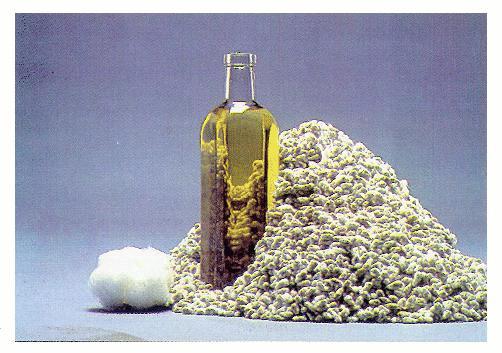
So phenomenal, in fact, the 44 million metric tons of cottonseed that we produce can be converted into 10 million metric tons of protein!
All in all, the work being done with cotton as a food source really first became public knowledge in 2006, and scientists believe it will take about a decade to develop edible cotton varieties for commercial use. That means in about 5 years this could be a reality. This is a testament to work being done in production agriculture to change processes our ancestors used to better accommodate a growing population.
Tuesday, October 26, 2010
Cotton is King [Part 1]
This is part 1 of a 2 part post on Cotton as a crop, fiber product and food - Enjoy!
Back home, one of my favorite harvest seasons is underway. It's cotton picking season and the strippers are buzzing through the fields. To begin talking about Cotton, since it is a crop we might be less aware of, I thought it might be nice to explain how this crop gets from the farm to the consumer. Cotton is grown in 17 states and the U.S. is ranked third in world cotton production behind China and India. Texas begins harvesting cotton in late July and the season can go into late November in northern states.

 Each little white ball you see in the field is referred to as a boll. Cotton is transferred from the stripper to the boll buggy. The boll buggy carries the millions of little cotton bolls to the edge of the field. The picture below depicts a boll buggy emptying into a module builder. The module builder sits at the edge of the field out of the way for the cotton stripper to continue stripping.
.jpg)


Stay tuned for Part 2 of Cotton is King. Cotton is normally thought of as a fiber product, and a darn good one at that! One bale of cotton can produce 1,217 men's t-shirts! The upcoming post will be more about how cotton can be and is utilized as a food product.
This is what cotton looks like in a field when it is ready to be harvested. This is a field not far from my home near Satanta, KS.

Cotton is removed from the field by a machine called a cotton stripper. It is similar to the combines that harvest grains, but a little different. While the invention of the cotton stripper highly improved the process from the old days of picking cotton by hand, unfortunately for cotton producers, a cotton stripper also harvests a lot of foreign material too. Foreign material can consist of burs, sticks, fine leaf trash and soil particles. The more foreign material contained in the stripped cotton the more grade reduction and price loss at the gin.
This is a cotton stripper, running along side it is a boll buggy being pulled by a standard tractor.
 Each little white ball you see in the field is referred to as a boll. Cotton is transferred from the stripper to the boll buggy. The boll buggy carries the millions of little cotton bolls to the edge of the field. The picture below depicts a boll buggy emptying into a module builder. The module builder sits at the edge of the field out of the way for the cotton stripper to continue stripping.
.jpg)
After the cotton is transferred into the module builder, it is compacted into a large module. Modules are formed to protect the cotton and as a way of storing the cotton until the gin is ready. One module is usually about 13-15 bales of cotton. One bale of cotton weighs around 500 pounds. In the last couple of years total US acres have averaged .6 bales per acre of cotton planted overall. My dad always hopes for "2-bale cotton" which means his goal is to harvest 2 bales per acre or 1000 pounds per acre. The picture below shows several modules of cotton sitting on the edge of a harvested field. The green tarps on top serve as protection from any rain or weather elements that the cotton might be subjected to. Large numbers are painted on the side of each module for identification, and when the gin is ready to take more modules in, a truck will come and pick up the modules and transport them one by one to the gin.

While producers in Kansas used to have to send their cotton to other states to be ginned, in the last decade a few gins have popped up in the southern part of the state. My family is fortunate to be a member of the Northwest Cotton Grower's Co-Op Gin. It is located near Moscow, KS which is a hop, skip and a jump away from my home town. We are in the Southwest portion of Kansas, but it is the Northwest area of typical cotton growing states.. When the gin was built it made cotton a more profitable crop for our area farmers because it greatly reduced the transportation costs involved with shipping modules south to Texas for ginning. Cotton is also profitable in our area because it requires a lot less irrigation than corn or milo and you can grow it in soil that isn't as superior.
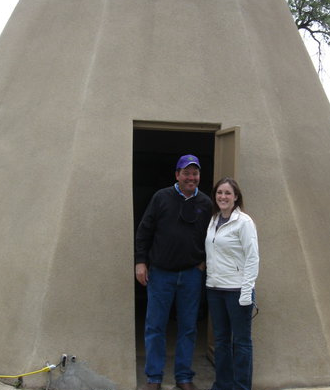
If you would like more information on Cotton in the U.S. the best website to refer to is the National Cotton Council of America. I got a lot of my information off of their website and also from my dad. He is a third generation farmer and a second generation cotton grower. His farm is currently harvesting the cotton crop and they are pretty excited because cotton prices are good right now. Here is a picture of my dad and I in my home town, Satanta.
Stay tuned for Part 2 of Cotton is King. Cotton is normally thought of as a fiber product, and a darn good one at that! One bale of cotton can produce 1,217 men's t-shirts! The upcoming post will be more about how cotton can be and is utilized as a food product.
Subscribe to:
Posts (Atom)
LinkWithin
