Search This Blog

Showing posts with label grain. Show all posts

Monday, July 15, 2013

Wheat Harvest in Kansas

My brother harvested his first wheat crop this summer and finished up right before the 4th of July. It wasn't the first crop on our family's farm, he is now the 4th generation of farmers in the family!

This year was the first year we had our own combine and harvested our own crop. We normally hire what is referred to as a custom grain harvesting crew. They travel from the Southern US to the Northern US following the ripening of the wheat crop to harvest wheat for farmers at a set fee. Farmers call these people, "Custom Cutters." Farmers often hire custom cutters because you don't have to invest in all of the harvest equipment and incur the repair costs that it requires to maintain all of the machinery needed for harvest.

Even though it is still extremely dry in Southwest Kansas, the wheat was better than we had expected. We got a few late freezes in April and May that really set back the wheat and made my dad and brother nervous about the yields.  It was no bumper crop, but it just wasn't as terrible as they had expected.

Want to learn more about harvest? Check out this video from the Peterson Farm Bros!

Want to learn even more about harvest? I thought of some of the vocabulary that we use on the farm and you might find it useful to learn more about these words.

  • Yield: this is a term we use to describe how much of a crop we harvest per acre of the crop planted. We usually talk about yield using bushels and acres. Some other countries use tons per hectares. 
  • Combine: a piece of machinery specifically used for harvesting grain. It operates to reap, thresh and winnow the plants in order to gather just the grain for transport to the nearest grain elevator, barge or train. Crops that are harvested with a combine are wheat, oats, rye, barley, corn, soybeans and flax.
  • Bushel: a bushel is a volume measurement used by farmers to describe an amount of grain. It is equal to 1.244 cubic feet or 32 quarts. 
  • Test weight: this is a measure that farmers will use a lot in conversation. It is the measure of the weight of grain in pounds per volume in bushels. Wheat has a standard weight at a specific moisture content and it is 60 pounds per bushel at 13.5% moisture. 
Sometimes we forget that, in agriculture, we have our own lingo. I like to post about that lingo so that you can get a better understanding of what it is we do on a family farm.  Heck, there are even multiple words that all mean "Harvest" and are used with different crops. Many of these terms are regional, but it's interesting to hear people talk about how they all harvest their crops.

Synonyms for Harvest: 
Corn: shell, pick, shuck
Beans: run, cut
Wheat: cut, thresh
Cotton: pick, strip
Silage or Hay: lay down, cut, chop


Enjoy!

Tera


Sunday, June 2, 2013

Superfood: Flax Seed


Flax Seed: Up close and personal.
You may find flax seed in your local grocery store, check in the cereal or supplement aisle. It's considered a superfood, a fad term given to food products that are high in a nutrient content that is believed to be a health benefit.

What ingredient is so SUPER in this oily seed? Omega-3 fatty acids.

Jim Drouillard, a professor at K-State, has been researching flax seed for the last decade. Not in human nutrition, but ruminant. Ruminants are mammals that digest plant-based food because they have bacteria and protozoa in their digestive tract that can help them out! There are about 150 species of ruminants, but Dr. Drouillard is interested in cattle.

He has found that feeding flax seed to cattle in the five months before they are ready to be slaughtered can help make these animals more healthy. He set out to improve the health of the animals, but also found that it increases the amount of omega-3 fatty acids found in the meat from the animals fed flax seed.

NBO3 Technologies is a Kansas-based company that launched a ground beef product that is high in omega-3 fatty acids. Flax seed is pretty expensive, but for consumers who are willing to pay for the higher priced beef product, it's a good option.   

It also goes to show that the research done at Universities like Kansas State, is groundbreaking and necessary for advancement in today's society.


Always a Wildcat,

Tera 

Sunday, February 24, 2013

Favorite Posts of the Past

Readers,

If you haven't caught some of these posts, I wanted to make sure you had easy access to them. These are the posts that generate the most attention on our blog. Please take a moment to read them if you are interested and haven't gotten a chance to do so. Hyatt Frobose hit it out of the park with the post coming in at the Number One spot! Maybe that will convince him to write some more posts for you guys!!!

  1. Does America Need a Fat Tax - 6607 pageviews
  2. Extra Extra Read All About It - 4532 pageviews
  3. Sweet Corn Vs Field Corn - 3966 pageviews 
  4. Colorful Cauliflower - 2908 pageviews
  5. Getting to Know Your Beef - 2601 pageviews
What has been your favorite post on the blog?

Enjoy,

Tera

Sunday, February 17, 2013

Fields of Gold

You'll remember me when the west wind moves...........Upon the fields of barley
You can tell the sun in his jealous sky........................When we walked in fields of gold

Picturesque field of gold.

This blog post was inspired by a song playing on my Pandora while I was supposed to be studying. My family doesn't grow barley, but I thought I'd do a little research on the crop because that song is just so good!

Barley: cereal grain grown in both irrigated and dry land environments. 

Season: barley is a short-season crop, 27 states in the US produce Barley.

North Dakota: state that grows the most barley in the US.

4th Place: barley is the fourth largest grain crop after wheat, rice and corn. 

320 million: average number of bushels produced in the US between 1994 and 2003. 

Animal feed: number one commercial use for the crop (51%), followed by malt (44%).

Resources: Barley Foods, National Barley Growers Association

Barley ready for harvest.


Enjoy, 
Tera


Monday, October 3, 2011

Welcome To My Sister's Family Farm

Celebrating harvest time for some people = apple cider, football, mums, pumpkins and craft fairs.

Celebrating harvest time for farmers = late nights, early mornings and hopeful wishes for a bountiful crop.

With corn harvest over in my neck of the woods, I thought I'd share a few photos from my sister's farm in Illinois. She married a man she met in college who is originally from the central part of Illinois. Transplanting a Kansas girl into Illinois wasn't an easy task, but seeing as they transplanted her to a farm made it that much easier.

Their family raises corn, soybeans, a little bit of wheat and for fun, a few vegetables (my favorite are their green beans). My brother-in-law is fortunate enough to work on his farm with two brothers and his father. They are a team in every sense of the word and have a very successful farming business. What I think is even more special about their farm is that for many years, the boys were able to learn from both of their grandparents who farmed in the area before they took over.

 These are some aerial shots of the 3 combines running through the field. I think these are beautiful shots of harvest time in Illinois.
These photos were taken by their agronomist. Their agronomist works for Pioneer Hi-Bred and offers her services to collaborate with the farmers and the seed companies to continuously improve products that Pioneer offers its customers. Pioneer Hi-Bred is a seed company that breeds different lines of corn seed for farmers to plant. Picking a seed company is a lot like choosing a bank. Farmers make their decisions on who to purchase seed from based on the data behind the specific breeds of corn that a company offers.

This is a really neat site that shows the various crop reports as they are coming in across the country. You can see different states by changing which view you are in. The data is presented in bushels per acre. That means that for every acre of farm ground planted to corn this is how may bushels of corn is yielded. You can also see the soybean harvest reports. If you forgot what a bushel is you can check out this post.

 I have to leave you with my favorite photo: 
With three combines running at the same time, my brother-in-law wanted a way to distinguish his combine from the other two. Proudly sporting a chrome powercat, his combine was out in the field this weekend during the big win for the Wildcats! During harvest, farmers are working around the clock since it is the most important time of the year for them. They are feeding the world, though, so even K-State football can wait.

Best,

Tera

Monday, June 13, 2011

What goes into your bread?


Want to know what goes into your bread? Straight from the farm, I'm bringing you a combine-driving farmer from Reno County, KS via Food For Thought's first video blog! Check out the video below -


If my video post did not answer all of your questions about wheat harvest in Kansas, please let me know and I would be happy to fill you in!

My best,

Brandon Harder

Wednesday, February 2, 2011

Been there, done that!

Have you noticed how so many critics of the food industry go on and on about how they "think" food is produced on "factory farms" here in America? How many of them have actually been to the farms, ranches, feeding lots, and packing plants where food is produced? Maybe before writing a book or article condemning the food industry, one should take a look at it first hand.

Check out this article about Ryan Andrew's, self-proclaimed plant-based eater, visit to Magnum Feedlot in Colorado. A good friend of mine's family owns Magnum, and I am proud that they opened their gates, allowed for their operation to be transparent, and took the time to educate a weary consumer.


Before you've been there and done that...don't read everything you believe. Know the truth behind where your food comes from!

Thursday, January 6, 2011

The Story of Corn: As Told by a 4-year-old.

You may remember my post written this summer, The Story of Wheat: As Told by a 3-year-old.

Well this fall Cameron turned 4! He also got to see corn harvest at our farm. Irrigated corn is the main crop that we harvest and by the end of the season our combines have shelled close to 1 million bushels of this crop. Remembering what a bushel is, that is a lot of corn! Today while traveling to my hometown with my nephews in tow, we passed the John Deere dealership in a nearby town. Cameron spotted a combine with a corn header on it. This brought on the story of corn, and it goes a bit like this:

(his words, not mine, and you are lucky it's my spelling!)

  1. Corn is a kernel and Papa's tractors plant it in the dirt in rows.
  2. Papa has to water the corn to get it to grow.
  3. We eat corn when the petals are green, but cows eat it when the petals turn brown.*
  4. When the corn turns all brown Papa can cut it with a combine.
  5. He has to put a corn header on the combine, it's the pointy one, not the round one!**
  6. The combine pours corn into the grain cart.
  7. The grain cart dumps it into a big big truck.
  8. The truck takes the corn to the elevator.
  9. The elevator loads up train cars that will take some of the corn to the cows for them to eat.
  10. That's the story of corn, Tera, yep that is the story of corn.
*Here he is referring to the sweet corn that he likes to eat so much. I wrote a post about the difference between sweet and field corn a while back. You should check it out if you haven't read it. Our farm grows only about one acre of sweet corn. Just enough for our family and friends to enjoy. Sweet corn is ready in July usually and the leaves (or petals!) are still green when we hand pick it. The rest of the corn crop is field corn and it is harvested in September by large combines when the leaves have turned brown.

**A combine is a large piece of machinary that harvests grain crops. It will cut the plant, take in and separate the pieces of grain and shoot out the extra stems and leaves. Combines come with removeable heads that are designed to harvest different crops. The most common one you will see is called a grain platform or standard header. It is used to cut cereal grains. Most farmers use a specialized corn header to harvest corn. Cameron sure loves combines!


This is a combine with a standard header attached to it. Cereal grains are harvested with this header and are things like wheat, rice, oats, and barley and are referred to as staple crops because they produce more food worldwide than any other crop.

This is a combine with a corn header attached to it. Now you can see the pointy things Cameron was referring to!

Enjoy!

Tera

Wednesday, October 6, 2010

Foodie Feature: Milo and Oats (not Otis)

So it’s a well known fact that this wheat:


can be made into this bread -->


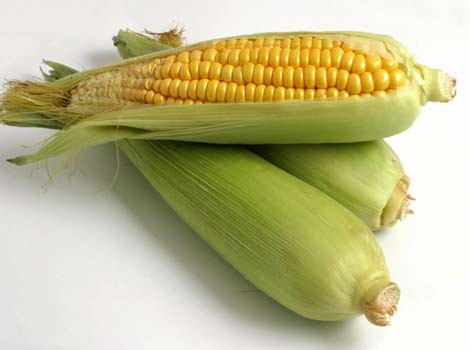
It’s also generally accepted that this corn is a key ingredient in these tortillas
<--                                         -->
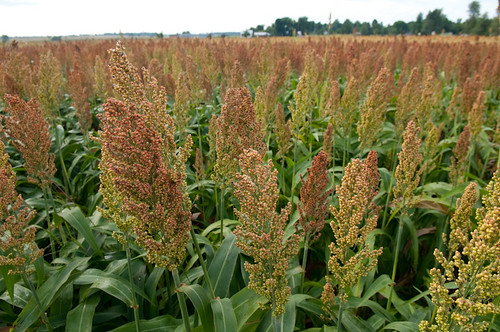
But do you know what this is and where it is used?

This crop in this picture is milo, also known as sorghum.   It's a very drought and heat tolerant grain that is a key component of some livestock feeds, sorghum molasses and some adult beverages.  Sorghum is an used as a foodgrain across the globe but in many regions of the world, such as South America, India and Africa, sorghum is a staple in everyday diets.  Did you know that sorghum is the 5th most important cereal crop grown in the world?!  Sorghum is also highly palatable to livestock and is therefore used in the U.S. primarily as livestock feed.  It has more protein and fat than corn and doesn't decrease productivity.

Another important grain that rarely gets attention are oats.  This is what they look like on the stalk, prior to harvest.
But you probably see them more often looking like this -->
Did you know there are lots of other uses for oats?  Oats can be made into flour, used in cookies, mixed into horse and livestock feed and are commonly found in most granola bars.  Great Britain often uses oats in breweries when making beer.  Oat protein is nearly equivalent in quality to soy protein, which has been shown by the World Health Organization to be equal to meat, milk, and egg protein.  Oats are also believed to lower bad cholesterol and possibly reduce the risk of heart disease.  Oats provide the body with a ton of healthy benefits!

Sorghum/milo and oats are two grains that don't get very much well deserved attention.  Next time you're in the grocery store pick up some heart healthy granola bars and some sorghum molasses!

For more information on grains and crops visit http://www.ksgrains.com/

Until next time,
~Buzzard~


Tuesday, September 28, 2010

Factory Farming will Feed the World


I don’t like the term “factory farming”. I frankly don’t think it exists. In my mind it is nothing more than a simple-minded attempt to abolish the way of life 2% of the US population enjoy passing down through generations – kind of like picking a fight with a kindergartener at our age. I just used it in the title to catch your attention. Did my gimmick work? Keep reading.

A mere 2% of our population produces safe, nutritious and surplus food for our country and the world. The topic of hunger is one that hits everyone hard. Somewhere in the ranks of 1 billion people, as of 2009, are currently going about life hungry. These people walk the streets in countries around the world, including the US and is a widespread crisis.

World leaders look to agriculture to solve these problems. While agriculture in the US is dealing with anti-agriculture activists on a daily basis and spending millions of dollars to promote the positives of the industry to US consumers, the rest of the world is looking to agriculture to solve the immense hunger problem. Ag producers are trying to introduce the American consumer to the face of farmer or rancher while dispelling myths about factory farming and large-scale mechanized food production. Agriculture is fighting a different battle in the US, while the rest of the world needs it to help fight hunger.

At a recent United Nations meeting, the Summit on the Millennium Development Goals in New York, James Borel, Dupont executive vice president, hammered this thought home. “Agriculture is the primary driver to abate hunger and reduce poverty. Throughout history, agriculture prosperity has led to successful economies,” he comments.

Wait, wasn’t Dupont just being bashed in US popular media for biotechnology practices in crop production? Biotechnology, which undoubtedly only benefits the factory farms and evil, smoke-out-the-ears caricature of ‘farmers’ who run them. Yeah, that’s how the video went.

Dupont and other US crop seed companies have created efficient, sustainable, drought and insect resistant seeds through biotechnology. But we can’t just take our biotechnology into a developing country, teach farmers how to plant our more efficient biotech crops, fly back to the US and celebrate because we solved the problem. Those farmers will see success in the first crop. Yields will be tremendous, but there will be no infrastructure to support the surplus. Next year they will be frustrated, we won’t provide them with biotech seeds again, and they will return to how it used to be.

The point? Solving hunger and increasing overall food production around the world is a complex problem that can’t be solved with one answer. I believe what Borel says in that agriculture is in the answer, but I don’t think it is THE answer. We can battle hunger with an intricate plan including economic and agricultural development around the world.


Just my two cents,


Tera Rooney

Monday, September 6, 2010

How much is a bushel?


The air is getting cooler, the grass is browning and the mood is changing. It's that time of year.

You may be thinking, yes it is football season. Get on your gear, hop on the couch and pop open a cold beverage! But I'm talking about a different kind of season - corn harvest. Since corn is the main crop we produce, this time of year is our Super Bowl!

My family produces irrigated corn, which was especially strenuous this summer because of the amount of days over 100 degrees. When it is that hot out for that long, it's hard to keep up on the irrigation and keep the corn plants from being compromised. We're hoping for a good harvest and awaiting the yields.

You will hear the term bushel thrown around a lot this time of year in the agriculture industry. What exactly is a bushel?

  • a bushel is a unit of measurement used to describe dry ingredients
  • it is used to describe agricultural products like wheat, corn, apples, etc.
  • it contains 4 pecks or about 8 local gallons (you have to say local because UK gallons are larger than US gallons, thus UK bushels are also larger)
  • it measures volume not weight
  • bushels can help you understand yield, but you have to be careful with weights because it is probably clear that a bushel of apples weighs out differently than a bushel of corn
  • the USDA has a set of standard bushel weights that I have listed below
  • a lot of farmers will talk about wanting "250 bushel corn" and that just translates to the goal of producing 250 bushels of corn per acre planted
  • while you may see traditional bushel baskets in the grocery store holding apples or peaches; corn is harvested, taken to an elevator or barge in large trailers and weighed out on large scales

USDA Standard Bushel Weights
Crop
Lb.
Soybeans, wheat 60
Flax, rye, shelled corn, grain sorghum 56
Corn-and-cob meal (ground ear corn) 45
Cracked corn, corn meal 50
Barley 48
Oats 32
Apples (Eastern) 42
Apples (Colorado) 40
Peaches 50

Enjoy your football season and think about the farmers in harvest!

Tera Rooney

Wednesday, August 4, 2010

Welcome to My Family's Factory Farm

It is with inspiration from an excellent article written by Marlys Miller, an editor for Pork magazine, that I write this post. The article does a great job of clearing the air and posing the question of what it is that actually defines a family farm. I've thought a lot about this very subject this past semester and found that it is more helpful if a consumer can be welcomed on to a family farm to learn first hand how they would categorize it. So without further ado, I welcome you, to my family farm.


This is my family's farmstead. It is located 5 miles outside of the bustling metropolis (sarcasm) of Satanta, KS. My father is the 3rd generation of Rooney's to work on the farm. This google map is not exactly current because there are cotton modules sitting in the field west of the house (cotton is harvested in late fall) and we have yet to replenish the hay bales this season (we bail corn/milo stalks and that won't happen until harvest early this fall) that are sitting in the middle of the lot in this photo.


Rooney Agri Business is what my family's farming operation is called. It consists of 3 equal partners - my dad, my uncle and my grandmother. We have 4 hired hands who help with the daily tasks on the farm.


We grow corn, milo, wheat and cotton. Most of our land is irrigated with pivot irrigation systems and located in Haskell, Grant and Stevens counties.


My mom helps keep the books for the farm and argues with dad when the office gets too messy. When we were younger all of us kids helped dad out on the farm. He liked to make us walk sprinklers and change nozzles, "for fun!"

We also have a herd of registered Maine-Anjou cows. We are able to utilize the dryland corners off of dad's farmland by letting the cows graze the wheat in the winter into early spring. We also calve all of our cows out on the corn stalks close to the farm. This provides extra feed for the cows during the colder months and a warm, dry bedding for the baby calves.

My family takes pride in our farm, they have for several years and will continue to work hard to keep it viable for future generations. We have a large operation that covers a lot of acres and feeds a lot of mouths, but that doesn't mean we still aren't a family. It is easy for me to define the parameters a family farm and dispel the idea of factory farming because I grew up with it. For an average consumer, it's not as black and white.

Family farming is alive and well in the U.S. You can not judge by the number of acres that are worked to give scope to a farming operation. The best way to find out is to see whose hands are doing the work, and on 98% of American farms in 2007, those hands belonged to the family.

All my best,

Tera Rooney

Wednesday, July 28, 2010

The Story of Wheat: As Told by a 3-year-old

Even though Kansas wheat harvest is long over and the stubble is the only remnant of this crop left scattered across fields in the U.S., the story of how wheat goes from farm to fork has never been more exciting to me!

Let me rewind. I am visiting home for a friend's wedding and it is County Fair time in my home county. My life used to revolve around the Haskell County Fair and the events leading up to, during and after. As I pulled into town, I was quickly reminded that tonight was the night my nephews were going to visit the fair and see the animals. Of course I wanted to be involved and tag a long, purely for entertainment value.

Cameron and Gavin are my bright-eyed, energetic, beautiful 3 and 2-year-old nephews. Tonight standing in the cattle barn on the fairgrounds, Cam on one hand and Gav on the other, I may have had my proudest moment ever! We were talking about the different things that cows eat to make them grow. Cam asked if they ate wheat and before I could answer he proceeded to tell me the story of wheat, and it goes a bit like this:

(his words, not mine)
  1. Wheat starts as a seed and Papa puts it in the dirt with a tractor.
  2. It grows up green first like grass and then turns yellow like Mimi's hair.
  3. When it's yellow that means it is ready to be cut by the big big combine.
  4. The combine puts the wheat in the bin thing and the auger thing comes out.
  5. Then it's all dumped into the grain cart.
  6. Then the grain cart dumps it into a semi-truck
  7. Then the semi-truck takes the wheat to the elevator.
  8. Then the elevator weighs it and puts it on the train.
  9. My daddy helps fill the trains. I like trains.
  10. Then the train takes the wheat to the trade house. (Chicago Board of Trade maybe? Oh yeah, he's 3!)
  11. The trade house sells it to the food makers.
  12. The food makers make food for us to eat!
  13. Then wheat starts as a seed again and Papa can put it in the ground.
  14. He would've continued in a round had it not been for the cow that stood up to defecate. That caused quite a bit of ruckus and a sudden fascination with fecal matter.

So that is how wheat goes from farm to fork according to my nephew. I'm sure most of that was told to him on one of his countless tours of the inside of Papa's combine this summer - especially that part about the Chicago Board of Trade! Either way, his fascination, memory and love for the process of growing food for people made me the proudest Aunt ever. No doubt about it, Cam's going to make an amazing agriculturist some day. If you want to learn more about wheat from a grown up, check out this post I wrote a few months back!

Take your kids, nephews, nieces, siblings, friends, etc. to a County Fair near you. It is an amazing opportunity to learn more about agriculture and the food industry!

Always,

Tera

Tuesday, June 15, 2010

Ninety Five

Corn Farmers Coalition has released a new ad. It's aim? To put a face on farmers. 

Most American farms are owned by families. More specifically, 95% of corn farms are family owned. The mission to spotlight these family farms comes at a time when it is important for consumers to understand that corporate farming is more of a myth than a reality. 

“They aren’t some myth, but are a critical economic engine that provides most of the food, feed and fiber produced in this country,” said Darrin Ihnen, president of the National Corn Growers Association. “This awareness is important to our survival."

Sometimes I wonder where the idea of corporate farming and big agriculture first began. Many farms that I know of are actually "incorporated" for the tax advantages only. Behind that label, is a hard working family of dedicated agriculturists. 

Family farmers deserve a face that is honest, realistic and shows the world exactly where food is being produced. A friend of mine did an excellent job of literally painting faces for farmers in this recent post. Just look at her photos and you can see the years of diversity, generations of pride, and hours of hard work it takes to keep the family farm up and running. 

Ninety five. I'm proud to be a part of that percentage of American Farmers!

Tera Rooney

Monday, May 3, 2010

Tailgate Lectures: Corn Farmin' Kids


When my brother and I were little I can remember our obsession with planting our own corn fields in May when dad set off in the tractor to sow his many acres. We wanted to grow our own corn on the cob to enjoy! We plotted out a square behind the barn and planted the little seeds we picked up off the ground outside the machine shed. We had to flag off our plots so that Grandpa wouldn't accidentally mow them over. He always taught us about picking a fertile piece of ground and remembering to water the plants each day. He taught us about conserving the land and being responsible with pesticides and herbicides. He taught us about our family history and how generations had planted the same piece of ground year after year. He should have taught us a little more about patience because it takes about 3 months for a corn plant to finally tassel and in little kid time - that is a century! When the plants would finally mature enough to produce an ear, you can imagine the built up excitement that my brother and I possessed. After shucking the first ear we were so thrilled about our end product and excited for our sweet, succulent corn on the cob.....we were absolutely thrilled, that is, until we realized it was field corn!

 So, what's the difference between field corn and sweet corn? 
  • Sweet corn is often sold in the produce aisle at the grocery store. 
  • It only accounts for about 5% of the corn grown in the U.S. 
  • It is bred for it's sweet taste. 
  • It is harvested in the milk stage when the kernels are soft. 
  • It is more susceptible to pests and stress. 
  • It often produces much lower yields. 
  • It is planted later than field corn when the ground is warmer.

  • Field corn is often used in animal feeds or processed further for human consumption.
  • It is bred for it's starch value. 
  • It is harvested in the hard and relatively dry kernel stage. 
  • It is much hardier, taller and has much wider leaves than sweet corn plants.
  • The seed kernels are much smoother. 
  • It is genetically dominant to sweet corn. This means that when a pollen from a field corn plant pollinates sweet corn, the kernel will always result in field corn. 
  • You can eat field corn, just like corn on the cob, but it is not preferred. 
For more information, and if you'd like to plant your own sweet corn plot this spring - contact your local Extension Office. Or you can visit this Extension.org!

Now I'm craving some roasting ears, 

Tera


Sunday, February 28, 2010

Amber Waves of Grain


With the recent announcement of the Topeka, KS, Horizon Milling flour mill's plans to shut down, I found a few interesting websites targeted towards consumer education in wheat food production. Work done by the Wheat Foods Council is a great example of how agriculturists can help bridge the gap between producers and urban consumers.

Wheat is grow in 42 of the United States, making our country the largest exporter of wheat in the world. Wheat farmers, along with other agriculturists who produce grain, meat, fruits and vegetables, work hard to feed a hungry world.

Take a look at this website to see exactly how wheat goes from farm to fork in a phase-by-phase interactive wheat farm. You won't get to see how farmers can take advantage of wheat's natural growth patterns by grazing cattle on it during the winter, or smell the fresh cut straw during harvest season, and although these are some of my favorite parts of wheat farming, the interactive wheat farm is a really neat tool.

Another successful program that the Wheat Foods Council sponsors, is the planting of an Urban Wheat Field. During this event in October, the council illustrated the life cycle of a kernel of wheat by harvesting the field, demonstrating milling methods and bringing the flour through the production line to bake loaves of bread for people in the City of New York.

What an excellent example of an industry-driven attempt to help consumers understand where their food comes from. I hope other aspects of food production can adapt and implement more programs like this.

All my best,

Tera Rooney

LinkWithin

Related Posts with Thumbnails