
Search This Blog

Showing posts with label ranchers. Show all posts

Tuesday, March 15, 2016

Every Day is National Agriculture Day

Every Day is Agriculture Day

Happy National Agriculture Day! On March 15th, universities, organizations and individuals from across the United States will celebrate the role that agriculture plays in our everyday lives. Having an agricultural background, the strangest phrase that I’ve ever been told is, “I really don’t have any connection to agriculture at all.” Knowing the diversity of agriculture, and everything that it has to offer, I think it’s important that we know that we all play a role in agriculture and that we all should be celebrating Agriculture Day!

The first thought that comes to most individuals minds when you bring up the word “agriculture” is the idea of the farmer, driving a tractor through his fields. Though this is an important aspect, more than 21 million workers in America (or about 15% of the workforce) is employed in the agricultural industry. Opportunities include careers in Park and Recreation Management, health-care and pharmaceutical packaging and food science.

This is also a great time for consumers to get involved in the agricultural industry because it provides a variety of choices. Grass-fed or grain-fed, all natural or organic, we are able to take advantage of each option because the hard working farmers and ranchers who dedicate themselves to our industry. Not only are these farmers and ranchers producing a variety of products for us to enjoy, there are also producing more with less. According the American Farm Bureau, today’s farmers produce 262 percent more food with 2 percent fewer inputs (labor, seeds, feed, fertilizer, etc.), compared with 1950.

Not only should we be celebrating agriculture in the United States, but worldwide as well. This past January, I was able to travel to South Africa with the National FFA Organization. During our 10 day stay, we were able to tour many different agricultural operations, including a family owned dairy, and even one of the top 5 producing farms in the country! My travels made me realize that agriculture is advancing all over the world!


Even though March 15th may be the official day of National Agriculture Day, it’s important that we celebrate the industry that feeds the our nation, and every nation around the world, everyday. So whether it’s sitting down to a meal, putting on that cotton shirt, or planting a new set of flowers to mark the beginning of spring, go out, and celebrate agriculture!

If you’d like to learn more about National Agriculture Day, visit (http://www.agday.org)

Yours truly,

Kyler Langvardt
Wednesday, March 18, 2015

National Ag Day 2015: What Does Agriculture Mean to You?

A spring wheat field in Kansas
A spring wheat field in Kansas.
Happy National Agriculture Day! Here's a quick question for your Wednesday coffee break:
When you think of agriculture, what comes to mind?

Do you think of a pasture full of cows? A waving wheat field? Apple orchards? I tend to think of a rolling wheat field, because I hail from the Wheat State. However, do the people of agriculture ever cross your mind?

Baby pigs and a face of agriculture
What's cuter than a baby pig?
I hope that you think of people when you think of agriculture, because the people who produce the food we eat are very important. That doesn't mean they are more important than doctors, teachers or firefighters but they still do play a vital role in our society. In fact, many agriculture producers are also teachers, firefighters, lawyers or students. All of these different people may help produce food in a unique way. A teacher may help his/her family raise cattle after the last bell rings. Similarly, many farmers or ranchers volunteer in their communities as firefighters, school board members or community leaders.

Agriculture is not a cookie cutter industry.

It's a complex chain of producers, consumers, retailers, agribusinesses, families and friends all working together to produce food for a growing world. Working with communities to provide good food that leads to healthy lifestyles. Working in conjunction with public health leaders, educators, public policy officials and many others to move forward with feeding the world. See a pattern? We are a nation working together, hand-in-hand, to feed the world. Pretty daunting task.

Today, on National Ag Day, I challenge you to think about agriculture and how you fit into our U.S. food chain. Do you make informed food decisions? Do you help produce food? Do you market, sell, distribute, promote or eat food? If so, you have an important role and should celebrate National Agriculture Day as a food enthusiast and agriculture impressionist.

Just some Food For Thought!
~ Buzzard ~

Monday, November 24, 2014

Thankful for a Life Around Cattle

Hey FFT Blog readers!  My name is Lindy Bilberry and I’m a new face on the Food for Thought scene.  I am currently a sophomore studying Agribusiness at Kansas State University and grew up around cattle—both in a beef feedlot and on our family’s cow-calf operation.  Growing up, I lived for the mornings that my dad would let me tag along on Saturday mornings to check cattle at the feedlot with him.  A lot of us are probably unfamiliar with what exactly happens in a feedlot, so I am going to share about my experiences in our operation.  Hopefully it helps us all to understand a little bit about how the cattle in the pens eventually become the hamburgers and steaks that we like to see on our plate!


Growing up, spending time around cattle was my way of life.  That’s me in the leopard print jacket with the calf.
One summer in high school, I had the chance to work as a ‘pen rider’ at Circle Feeders in Garden City, Kansas.  Basically, this meant that my job was to get on my horse every morning at 6:00 and ride through pens of cattle, checking to make sure that none were sick.  If we did find an animal that was sick, we would take it out of the pen and to the hospital (yes, we call the barn where sick cattle are treated hospitals) where the employees who are trained in animal health treat the animals for their ailments.  Circle Feeders had a capacity of holding about 13,000 head of cattle.  At that time, I was riding about one-third of the pens and on an average day I would pull maybe four or five cattle out for treatment.


Last summer my dad and I did some work at a feedyard outside of Garden City, Kansas.  This is a picture of what a large-scale beef feedlot looks like.
There is a lot of talk right now about antibiotic use in livestock and the fear that we are ‘drugging up’ animals in order to make them bigger.  I have had the chance to spend time in a lot of feedlots and around a lot of beef producers in my day, and I have never once found this to be the case.  People who are raising cattle, whether it’s in a feedlot, a cow-calf operation, or whatever, ultimately care about the health of their animals.  When I was working at the feedlot, I would pull animals out to send to the ‘hospital’ because I was worried about their well-being.  They weren’t treated with medicine to bulk up or get muscles, but rather to treat an illness.  They’re going to an animal doctor, just like we go to the doctor to get medicine if we have a sore throat or the flu or a fever.  Cattle are treated so that they can get back to feeling normal so that they can continue to eat and grow!

Questions, thoughts, comments, or concerns?  I would love to hear them!  As we approach Thanksgiving, I can’t help but think about how thankful I am to have grown up around cattle, feedlots, and producers who truly care about the well-being of their animals!
 
Until next time,
Lindy

Wednesday, May 7, 2014

USDA Ag Census - Geeking Out Over Agriculture

Big ranches. Small farms. Community supported agriculture programs. All of these are outlets where food is planted and raised for American citizens and, in many cases, the world.

But unless you live near a rural community, it can be really difficult to find a farm or ranch to visit in order to learn more about the food you eat, the farms that produce it and more importantly, the farmers and ranchers raising and producing it.

To make the vast endeavor of learning about your food a bit more manageable, the United States Department of Agriculture (USDA) has recently published the results of the 2012 Ag Census. Yes, I am aware it is 2014 but the USDA collects, combines and categorizes millions and millions of data points so it takes a while to make it easy to share.

A new facet to the Ag Census data are the easy-to-read infographics. Generally, if an individual wanted to look up how many operations in the U.S. specialized in beef cattle (619,000 according to the census), that person would have to scroll through pages of reports, Excel files and other documents looking for the exact right piece of information. However, this year the USDA has created some really nifty infographics that highlight some important and key components of American agriculture.

Infographics tell the story of the 2012 Ag Census
Click to enlarge
Source: USDA Ag Census 
You can see in the infographic above many answers to questions regarding current agriculture issues. For example, more than 57,000 farms or ranches employ the use of alternative energy sources (wind, water, etc). How cool is that?! Farmers and ranchers using alternative energy to produce food for the world in an environmentally sustainable way!
 
Another fact that isn't necessarily cool but provides some insight into the costs behind farming: Farmers spent almost $20 BILLION on seed in 2012, which is a 66% increase from 2007.
 
There is also a tool called Quick Stats, which allows you to build a specific query. For example, if you wanted to look up the average age of the principal operator on California farms that have only one owner/operator, you could do that with a few clicks [the answer to that query is 60.7 years old, btw].

I hope you'll take the time to geek out over these cool tools that USDA has developed - I have been playing with the Quick Stats function a lot and the infographics page says that new inforgraphics will be added in the future, so I am checking that page often!

What are some questions you have about ag that you are going to research using the USDA data?

Until next time,
~ Buzzard ~


Monday, September 24, 2012

Agriculturists Police Themselves


The agricultural community is capable of policing themselves and taking care of issues as they arise. My father and brother, Gary and Travis Theurer, have both been involved with a local animal cruelty case close to home. This past year, the Midwest has seen some of the worst drought conditions people have faced since the Great Depression in the 1930’s. This has resulted in drastic management changes by animal caretakers in order to keep the health status high of all the animals. On our farm and ranch, the drought has resulted in selling off some of our cows to have enough grass and forage available to feed all the cows in the summer, extra supplementation in the form of hay bales, lick tanks, and range cubes, and has also resulted in consistent monitoring of water situation to ensure all cattle had access to high quality water. However in this isolated incident, one particular cattle producer did not take the proper steps.
My father was contacted by the local sheriff department to see if he would be willing to help capture the animals and bring them home and care for them. Dad immediately wanted to help because he was informed of the condition of the animals and wanted to do anything he could to nurse them back to health. My dad and brother drove up to this ranchers’ place and gathered all the cattle and hauled them home. Both my dad’s and brother’s responses were, “These are the thinnest cattle I have ever seen. I’m surprised they even have enough energy to walk. These cows need a lot of care to help them along.” At home, the cattle were fed a forage diet. We were initially worried to start the cows on a high quality grain diet because the cows have not seen enough feed and would over-eat any grain product placed in front of them resulting in metabolic acidosis causing more harm to the animal rather than good. We developed a gradual step-up ration diet that would initially meet the minimal cattle nutrition requirements needed and then increased in order to add weight to the cows to get them back towards adequate conditions. We went to gather the cows the first part of July and they have currently added approximately 300 pounds due to the water and nutrition supply my family has been able to provide to these animals. I saw these animals a few weeks after they arrived at home when I was down visiting for the weekend and I saw them again a couple weeks ago. The progress they have made has been remarkable just do to some management practices. Video of the cows and news report of the animal cruelty case can be found here:
The reason why I chose to write this for a Food For Thought blog was just to show the ability of production agriculturists to not only care about their own animals but all of the livestock sector. The drive and passion people can have is outstanding in agriculture sector. While it was a sad and isolated event that animals suffered, people directly involved with production agriculture stepped in and tried to fix the problem the best way they could.

Until next time,

Miles Theurer

Wednesday, August 8, 2012

Rain makes corn.... and is a good thing!

I've started off a rather somber post with a song - I hope you enjoy having it stuck in your head for the rest of the day - also, I LOVE the intro to this song. These farmers are really adamant about the critical role rain plays in food production.

Corn makes lots of other things besides whiskey by the way; cereals, baking powder, vegetable oil. You get the point.

As you've probably noticed, there hasn't been much rain in the midwest this year - or in general, actually. In fact, a report from the USDA as of August 1 highlighted pointed out the following sad facts:

- 65% of U.S. farms are in areas experiencing drought
- Severe or greater drought is impacting 65 pecent of cattle production, and about 75 percent of corn and soybean production.
- As of August 1, more than half of U.S. counties had been designated as disaster areas by USDA in 2012, mainly due to drought.

I live in God's country (Kansas) and we've needed rain badly for the past 2-3 months. In fact, the state of Kansas has placed all 105 counties into a drought emergency status and all but 3 Kansas counties have been declared a disaster. The good news is that it's supposed to rain tonight; the bad news is that when we really needed the rain, it was nowhere to be found.

In May, which is a very crucial time on the corn growing timeline (most corn is planted in late April), Kansas received a statewide average of 1.10 inches of rain. That's not very much to get good seedling growth started. June and July didn't treat us much better which has really had a negative effect on both corn and soybean growth.

For visual explanation let's look at this ear of corn


that came from this field near my hometown in Anderson County, Kansas. That's my husband's hand and that ear of corn is only about 4.5 inches long. This is a sad, sad sight for farmers.

Folks, it's August 8. Corn fields aren't supposed to look like this for another six weeks or so. There are just a few tiny specks of green in that field, some fields don't have any green in them and the corn stalks are half the height of this field.

Then compare to this ear of corn from Wood County, Ohio, where they've gotten  more rain this year than we Kansans- about 2.6 inches in May. That number is still a decrease from their normal precipitation but if you look at the difference that an inch of rain can have on a corn crop, that's a pretty important inch!


Here they are side by side - again, the corn from Ohio is on the left and although it's not near the size that farmers would like, it is better than our poor little Kansas ears.


So what does all of this rain and crop talk mean for you, the consumer? Unfortunately, food prices will likely increase in the long run and let me explain how.

Livestock producers (beef, pork) are having to cull their herds to avoid spending so much money on feeds. This could lead to a short-term increase in the meat supply which will lower costs. However, in the long run, once the shortage of corn and soybeans reaches the retail end (cornmeal, flour, cereal) we'll likely see an increase in grocery prices.

Furthermore, if producers are selling off parts of the herd now, they will have less to sell in 10-12 months which will probably lead to a long-term increase in meat prices.

So, if in the next 6 months you notice meat prices decrease only to increase again, please don't be upset with the farmer or grocery store. Farmers, especially livestock producers, are getting hit very hard this year. Many crop producers have insurance but that type of reassurance isn't available for beef, pork and poultry producers. They must feed their livestock regardless of feed prices because they're committed to utmost care for their animals. To read more about the strain on livestock producers and the perilous conditions that Mother Nature has created, you can read this blog post by pork producer, Chris Chinn.

We'd love to hear your thoughts and concerns about the drought or your situation. Leave us some comment love!

Until next time,
~ Buzzard ~


Friday, November 11, 2011

Fly Over States

I'm sure this song has been out for quite some time but since I'm in Australia I haven't been able to tune into many American country stations so incidentally I just heard it last week. For your listening pleasure:


 I love this song because it serves as a reminder of the importance of the farmers and ranchers who are producing a safe and affordable food supply in those fly-over states.

Additionally, Thanksgiving is just around the corner so remember to thank a farmer while you're carving up your Thanksgiving bird (or ham)..

Until next time,
~ Buzzard ~

Thursday, September 15, 2011

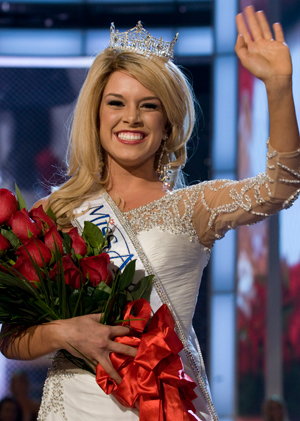
Miss America Coming to K-State


Yep - you read that correctly. Miss America 2011, Teresa Scanlan, will be the Food For Thought Fall 2011 Upson Lecture Series Speaker.

She will speak on November 15 at 7 pm in McCain Auditorium on K-State's campus and her lecture will be free and open to the public. So please, come join us!

The Gering, Nebraska native was chosen as our fall speaker for her dedication to production agriculture in the United States. Since being crowned as Miss America in January 2011, she has initiated partnerships with The Hand That Feeds U.S. and other agriculture groups in order to help spread the positive message about food production in the U.S.

She has been extremely vocal about her passion for agriculture, as evidenced here, here and here.

We hope that you will be able to join us in Manhattan for this momentous event - we are elated to be hosting Miss America and are looking forward to an exciting evening. Feel free to contact us if you have questions or would like more information!

Until next time,
~ Buzzard ~


image from here:

Tuesday, September 6, 2011

Red Meat - Green Facts

That's a fun little way of saying meat is sustainable and environmentally friendly. It's also the name of a website, which was created by Meat and Livestock Australia, that aims to "discuss the issues of sustainable farming practices." On the site you can further explore information about the "impact of farming on our environment and the proactive initiatives undertaken by farmers and processors across Australia."
One of my favorite features is a visual aid that helps consumers better grasp the supply chain from farm to fork. Check it out below:


Other links include facts about reducing water usage, myth busting (similar to this post), responsible land management and school projects. The myth busting tab is one of my faves.

 
For anyone looking to delve further into the facts behind food production, I highly encourage you check out this site. Although it was developed in Australia, many of the same principles and practices apply to farmers and ranchers here in the U.S. Furthermore, it's always a bonus to learn about agriculture in other countries, because it fosters critical thinking on how the global agriculture industry can improve worldwide.

 
Until next time,
~ Buzzard ~


Tuesday, May 10, 2011

Back in the Dust Bowl

An aerial view of a wheat field that failed to grow because of the drought in Haskell County.

Leaders in the Captiol here in Kansas have been hard at work to get 21 south western counties in Kansas recognized by the USDA as areas of natural disaster because of the recent drought that has caused crop and cattle production to dwindle. These are the counties involved in disaster areas: Finney, Gove, Grant, Greeley, Hamilton, Haskell, Kearny, Lane, Logan, Meade, Morton, Ness, Scott, Seward, Sheridan, Sherman, Stanton, Stevens, Thomas, Wallace and Wichita.


"Kansas if facing one of the worst droughts since the Dust Bowl days," said Sen. Pat Roberts in this article released today.


He's not far off. If you will remember my family's farm is in Haskell County where we attempt to raise wheat, cotton, corn and cattle. This year the wheat crop is non-existent partly due to the drought conditions and the fire that blazed through the area in April.


It's easy to see that it will be a rough summer for most farmers in the area. One thing many people won't think about is how the drought will affect cattle ranchers in the area. We don't have the lush green pastures of the Flint Hills in Kansas, but what we do have usually works for our cow herd. We turn our cows out in the spring on a pasture of mostly Bermuda grass that looks pretty dormant most years and greens up pretty good in April or May. Things are a little more desolate this year.


The greenest thing in the pastures back home might just be the algae in the water tank. Thus is the reason that this morning my Dad headed to the sale barn this morning with a big chunk of our cow herd. He culled any of our cows that were old or had structural problems. The reason we can't keep these cows around is because the feed that we normally depend on (the pasture grass) isn't there due to the severe drought conditions. This year we are hoping to be able to run 25 cows with their calves along side on 1000 acres of grass. We're not even sure that we will make it into the fall without supplementing them with feed and 1000 acres is a lot of ground!


Remembering that farmers and ranchers are the original environmentalists, the SWKS area will get through this drought just as it has in the past. Rest assured that farmers are doing everything possible to preserve the ground that they have signed on for a lifetime to be caretakers of. My dad will not be doing anything foolish with the ground he farms because he wants his son to be able to continue with the family business. Ranchers are also being responsible in how their cattle are cared for. Knowing that it's going to be a rough summer, my family will not be compromising the welfare of any cows that might have a hard time grazing the pasture ground we're dealing with. By selling them as cow-calf pairs we have, in a sense, given them an opportunity to move on to greener pastures!


What does this mean to you as a consumer? The southwestern corner of Kansas is a huge supplier of grain and cattle in the Kansas economy, which is also a huge supplier to the US food supply. You probably won't see a rise in prices at the grocery store, even though many farmers are going to see huge deficits on the profit margin. That's where understanding how American Agriculture works full circle and realizing that we are still able to feed our population through adverse weather conditions comes in.


American Agriculturists are working hard to literally put food on the table. We need consumer support and welcome any questions you may have.


My Best,


Tera Rooney


To read more:


LinkWithin

Related Posts with Thumbnails