
Search This Blog
Monday, September 17, 2012
BPI Suing ABC over 'Pink Slime' (Lean, Finely Textured Beef) Debacle
Hey - it's actually called Lean, Finely Textured Beef (LFTB).
You may have read/heard that Beef Products, Inc. filed a lawsuit against ABC and three news reporters (Diane Sawyer, Jim Avila and David Kerly) and are seeking $1.2 billion in damages for defamation. But you may be wondering how they can file a lawsuit against a news company and reporters. Let's get down to the facts, folks.
First off, we need to define defamation: it is the communication of a statement that makes a claim, expressly stated or implied to be factual, that may give an individual or business, a negative or inferior image. In Common Law it is usually a requirement that this claim be false and that the publication is communicated to someone other than the person defamed (in this case BPI is defamed person). (Wikipedia.org)
or in simpler terms:
Defamation is the false or unjustified injury of the good reputation of another, as by slander or libel (dictionary.com)
Basically, you can't go out and spread false information and not expect to be sued.
But what exactly is the claim against ABC?
BPI claims that ABC did knowingly publish and report misinformation in 11 television reports and 14 online news items relating to BPI and LFTB that were false and misleading, which aired from March 7 to April 3. In a press conference on September 13, BPI's lawyers expressed that ABC had been provided with real factual information about LFTB from USDA and several other sources and still chose to release 25 reports that stated otherwise. The pushing of a negative agenda caused hundreds of thousands of parents to ask their schools to cease use of LFTB in lunch programs and ABC also created and release a 'blacklist' of grocery stores who were using LFTB. That's a lot of negative press in a 28 day period. So much negative press that BPI lost 80% of their business and was forced to shut down 3 of their 4 plants and let go of 650 employees. Ouch.
About that misinformation - let's clear some of that up. Here are the facts about LFTB.
- LFTB is 100% beef. One hundred percent.
- LFTB is a USDA approved product that is sanitized and made safer with a minuscule amount of ammonium hydroxide mist.
- Ammonium hydroxide is present in most foods - cheese, cereal, beer, bread, even fruits and veggies.
- LFTB is 94-97% lean. Meaning that when it is used, the product is lower in fat and is healthier than a 80% or 85% lean product.
- The photo that was splashed across every TV station and newspaper of pink oozy stuff coming out of a machine is not representative of LFTB. It wasn't even beef.
So, that's the bare bones facts of it all. It will be interesting to see how this all plays out. I personally don't see how BPI could lose this case. There were over 500 pages of evidence logged with the claim and it's hard to ignore the hundreds of jobs lost and nosedive of BPI's business.
If you want to read more about LFTB here are some good links
Engineering a safer burger - Washington Post article
Beef is Beef - a collection of articles and more hard facts about LFTB
Q & A about ammonium hydroxide in food production
And if you have questions, we'd love to hear them!
So now that you have the facts, what's your take?
Until next time,
~ Buzzard ~
Monday, August 27, 2012
Does America Need a Fat Tax?
Dedicated readers,
Have any of you ever heard talk about state or federal governments putting in place a "fat tax"?
Our country has become the poster child for obesity in the modern world. While there are still around 1 billion people in the world that go to bed hungry, the USA and some other 1st world countries (I'm talking about you Australia and England!) are facing an obesity epidemic where, according to the 2010 WHO report, over 68% of the adult population is overweight and 34% are obese.
So.....what actions do we take to right the ship?
Some might argue that it is each person's own responsibility to maintain their health by eating better and exercising regularly. I think this is a logical thought process and everyone should be able to show a little restraint at the local all-you-can-eat $9.99 dinner buffet, or at least run a couple miles the next day to work it off.
However, some people have taken a different approach to possibly curtailing our intake of fatty, sugary and generally unhealthy foods. They argue that humans are unable to restrain themselves from eating the cheap, convenient, and often unhealthy foods that on-the-go Americans find themselves indulging in way too often. From a scientist's perspective, I find myself agreeing more and more with this argument because we are innately programmed through our sensory systems to prefer the foods that are more calorie-dense. To add even more credence to this, a 2002 study by Horgen and Brownell in the Journal of Health Psychology indicates that eating behavior may be more responsive to price increases than nutritional education.
Apart from the possible reduction in intake of unhealthy foods and drinks, a fat tax does offer some additional advantages. The tax revenue could be used to offset medical costs generated by obesity-linked health conditions, to improve nutrition education and to incentivize physical activity.
There are also many arguments against a fat tax. As a supporter of small government, I can appreciate those that don't want Big Brother involved in our food choices and telling us what we can and cannot eat. One of the most compelling arguments against is that a fat tax would be regressive, disproportionately affecting the poor. The poor typically rely more heavily on cheaper foodstuffs (typically those that are more highly processed and unhealthy such as fast food), and therefore some argue that a fat tax would be the equivalent of a tax on the poor.
One idea that I've had is that if we tax unhealthy foods, could we use the tax revenue as a way to subsidize healthy foods like fresh fruits, vegetables and lean meat so that food costs wouldn't increase as much?
The biggest hurdle regarding the implementation of a fat tax would be how to decide what foods and drinks would or wouldn't incur the tax. Perhaps we can wait and see what happens in Denmark, one of the only countries that has put a national tax on unhealthy foods.
If you have any input or thoughts on this topic, I would love to hear from you!
Thanks for reading,
Hyatt Frobose
Have any of you ever heard talk about state or federal governments putting in place a "fat tax"?
Our country has become the poster child for obesity in the modern world. While there are still around 1 billion people in the world that go to bed hungry, the USA and some other 1st world countries (I'm talking about you Australia and England!) are facing an obesity epidemic where, according to the 2010 WHO report, over 68% of the adult population is overweight and 34% are obese.So.....what actions do we take to right the ship?
Some might argue that it is each person's own responsibility to maintain their health by eating better and exercising regularly. I think this is a logical thought process and everyone should be able to show a little restraint at the local all-you-can-eat $9.99 dinner buffet, or at least run a couple miles the next day to work it off.
However, some people have taken a different approach to possibly curtailing our intake of fatty, sugary and generally unhealthy foods. They argue that humans are unable to restrain themselves from eating the cheap, convenient, and often unhealthy foods that on-the-go Americans find themselves indulging in way too often. From a scientist's perspective, I find myself agreeing more and more with this argument because we are innately programmed through our sensory systems to prefer the foods that are more calorie-dense. To add even more credence to this, a 2002 study by Horgen and Brownell in the Journal of Health Psychology indicates that eating behavior may be more responsive to price increases than nutritional education.
Apart from the possible reduction in intake of unhealthy foods and drinks, a fat tax does offer some additional advantages. The tax revenue could be used to offset medical costs generated by obesity-linked health conditions, to improve nutrition education and to incentivize physical activity.
There are also many arguments against a fat tax. As a supporter of small government, I can appreciate those that don't want Big Brother involved in our food choices and telling us what we can and cannot eat. One of the most compelling arguments against is that a fat tax would be regressive, disproportionately affecting the poor. The poor typically rely more heavily on cheaper foodstuffs (typically those that are more highly processed and unhealthy such as fast food), and therefore some argue that a fat tax would be the equivalent of a tax on the poor.
One idea that I've had is that if we tax unhealthy foods, could we use the tax revenue as a way to subsidize healthy foods like fresh fruits, vegetables and lean meat so that food costs wouldn't increase as much?
The biggest hurdle regarding the implementation of a fat tax would be how to decide what foods and drinks would or wouldn't incur the tax. Perhaps we can wait and see what happens in Denmark, one of the only countries that has put a national tax on unhealthy foods.
If you have any input or thoughts on this topic, I would love to hear from you!
Thanks for reading,
Hyatt Frobose
Friday, August 17, 2012
Incredible, Versatile, Healthy
I'm talking about eggs of course!
What other food can you eat for breakfast, lunch and dinner? Also, did you know that eggs contain almost every essential vitamin and nutrient needed by humans? True story.
One large egg contains over 6 grams of protein, and only 70 calories, - that's quite a powerful punch! Two eggs for breakfast is almost 25% of your daily requirement for protein and less than 10% of your daily caloric intake. I call that a bargain.
Incorporating eggs into every meal may be difficult for some - creativity runs short in my household. That's why I'm glad I found this infograph that is also quite fun. Created by Mark Bittman, food columnist for the NY Times, it shows a plethora of ways to make eggs the center of attention.
picture courtesy here
Check it out - tons of cool ways to eat eggs with salads, breads, veggies, meat - you name it! Try them all out.
Until next time (happy egg-ing),
~ Buzzard ~
~ Buzzard ~
Wednesday, August 8, 2012
Rain makes corn.... and is a good thing!
I've started off a rather somber post with a song - I hope you enjoy having it stuck in your head for the rest of the day - also, I LOVE the intro to this song. These farmers are really adamant about the critical role rain plays in food production.
Corn makes lots of other things besides whiskey by the way; cereals, baking powder, vegetable oil. You get the point.
As you've probably noticed, there hasn't been much rain in the midwest this year - or in general, actually. In fact, a report from the USDA as of August 1highlighted pointed out the following sad facts:
- 65% of U.S. farms are in areas experiencing drought
- Severe or greater drought is impacting 65 pecent of cattle production, and about 75 percent of corn and soybean production.
- As of August 1, more than half of U.S. counties had been designated as disaster areas by USDA in 2012, mainly due to drought.
I live in God's country (Kansas) and we've needed rain badly for the past 2-3 months. In fact, the state of Kansas has placed all 105 counties into a drought emergency status and all but 3 Kansas counties have been declared a disaster. The good news is that it's supposed to rain tonight; the bad news is that when we really needed the rain, it was nowhere to be found.
In May, which is a very crucial time on the corn growing timeline (most corn is planted in late April), Kansas received a statewide average of 1.10 inches of rain. That's not very much to get good seedling growth started. June and July didn't treat us much better which has really had a negative effect on both corn and soybean growth.
For visual explanation let's look at this ear of corn
that came from this field near my hometown in Anderson County, Kansas. That's my husband's hand and that ear of corn is only about 4.5 inches long. This is a sad, sad sight for farmers.
Folks, it's August 8. Corn fields aren't supposed to look like this for another six weeks or so. There are just a few tiny specks of green in that field, some fields don't have any green in them and the corn stalks are half the height of this field.
Then compare to this ear of corn from Wood County, Ohio, where they've gotten more rain this year than we Kansans- about 2.6 inches in May. That number is still a decrease from their normal precipitation but if you look at the difference that an inch of rain can have on a corn crop, that's a pretty important inch!
Here they are side by side - again, the corn from Ohio is on the left and although it's not near the size that farmers would like, it is better than our poor little Kansas ears.
So what does all of this rain and crop talk mean for you, the consumer? Unfortunately, food prices will likely increase in the long run and let me explain how.
Livestock producers (beef, pork) are having to cull their herds to avoid spending so much money on feeds. This could lead to a short-term increase in the meat supply which will lower costs. However, in the long run, once the shortage of corn and soybeans reaches the retail end (cornmeal, flour, cereal) we'll likely see an increase in grocery prices.
Furthermore, if producers are selling off parts of the herd now, they will have less to sell in 10-12 months which will probably lead to a long-term increase in meat prices.
So, if in the next 6 months you notice meat prices decrease only to increase again, please don't be upset with the farmer or grocery store. Farmers, especially livestock producers, are getting hit very hard this year. Many crop producers have insurance but that type of reassurance isn't available for beef, pork and poultry producers. They must feed their livestock regardless of feed prices because they're committed to utmost care for their animals. To read more about the strain on livestock producers and the perilous conditions that Mother Nature has created, you can read this blog post by pork producer, Chris Chinn.
We'd love to hear your thoughts and concerns about the drought or your situation. Leave us some comment love!
Until next time,
~ Buzzard ~
Corn makes lots of other things besides whiskey by the way; cereals, baking powder, vegetable oil. You get the point.
As you've probably noticed, there hasn't been much rain in the midwest this year - or in general, actually. In fact, a report from the USDA as of August 1
- 65% of U.S. farms are in areas experiencing drought
- Severe or greater drought is impacting 65 pecent of cattle production, and about 75 percent of corn and soybean production.
- As of August 1, more than half of U.S. counties had been designated as disaster areas by USDA in 2012, mainly due to drought.
I live in God's country (Kansas) and we've needed rain badly for the past 2-3 months. In fact, the state of Kansas has placed all 105 counties into a drought emergency status and all but 3 Kansas counties have been declared a disaster. The good news is that it's supposed to rain tonight; the bad news is that when we really needed the rain, it was nowhere to be found.
In May, which is a very crucial time on the corn growing timeline (most corn is planted in late April), Kansas received a statewide average of 1.10 inches of rain. That's not very much to get good seedling growth started. June and July didn't treat us much better which has really had a negative effect on both corn and soybean growth.
For visual explanation let's look at this ear of corn
that came from this field near my hometown in Anderson County, Kansas. That's my husband's hand and that ear of corn is only about 4.5 inches long. This is a sad, sad sight for farmers.
Folks, it's August 8. Corn fields aren't supposed to look like this for another six weeks or so. There are just a few tiny specks of green in that field, some fields don't have any green in them and the corn stalks are half the height of this field.
Then compare to this ear of corn from Wood County, Ohio, where they've gotten more rain this year than we Kansans- about 2.6 inches in May. That number is still a decrease from their normal precipitation but if you look at the difference that an inch of rain can have on a corn crop, that's a pretty important inch!
Here they are side by side - again, the corn from Ohio is on the left and although it's not near the size that farmers would like, it is better than our poor little Kansas ears.
Livestock producers (beef, pork) are having to cull their herds to avoid spending so much money on feeds. This could lead to a short-term increase in the meat supply which will lower costs. However, in the long run, once the shortage of corn and soybeans reaches the retail end (cornmeal, flour, cereal) we'll likely see an increase in grocery prices.
Furthermore, if producers are selling off parts of the herd now, they will have less to sell in 10-12 months which will probably lead to a long-term increase in meat prices.
So, if in the next 6 months you notice meat prices decrease only to increase again, please don't be upset with the farmer or grocery store. Farmers, especially livestock producers, are getting hit very hard this year. Many crop producers have insurance but that type of reassurance isn't available for beef, pork and poultry producers. They must feed their livestock regardless of feed prices because they're committed to utmost care for their animals. To read more about the strain on livestock producers and the perilous conditions that Mother Nature has created, you can read this blog post by pork producer, Chris Chinn.
We'd love to hear your thoughts and concerns about the drought or your situation. Leave us some comment love!
Until next time,
~ Buzzard ~
Labels:
Beef,
beef production,
corn,
crops,
farmers,
farming,
food cost,
Food Prices,
food production,
food supply,
Kansas,
livestock,
Meat,
pork,
rain,
ranchers,
soybean,
weather
Location:
Manhattan, KS, USA
Monday, July 9, 2012
Tears from a Cowboy
I told you in an earlier post that I am working at a beef cattle feedyard this summer. I am really enjoying learning all of the phases of production that go into getting beef on the table for all of us!
The yard I am at has the capacity to hold 50,000 head of cattle. It's a pretty big motel for the moo cows. Continental breakfast, complimentary lunch, the whole nine yards.
A couple weeks ago, I was sent with the head doctor. He is a cowboy who is in charge of doctoring any sick cattle. His cowboy peers ride through every pen on the yard each morning. If an animal appears to be struggling or has an impending illness, they walk him out of the pen and to the hospital barn. That is where the head doctor comes in to treat the animals as he has been trained by a veterinarian to provide high quality care to the cattle in the feedyard.
We had a black short yearling (slightly younger than a year old calf) in the chute ready for his treatment. I remember beads of sweat running down my face as it was about 109 degrees out that day. Cowboy took Blacky's temperature and looked up his individual record on the computer in the barn. Blacky was bloated which means his rumen (stomach) was producing gas that was building up because eructation wasn't occurring properly. While we had him in the chute Cowboy noticed his breathing was extremely compromised. He wanted me to grab a tube from his truck so that we could put it down Blacky's throat into his rumen and let the gas out so that he could breath better. When I ran back into the barn, Cowboy was on one knee by the chute.
Blacky had laid down in the chute and died. His enlarged rumen had suffocated him. Cowboy had his straw hat in his hands. A tear rolled down his cheek through the dust covering the man's face after a hard day of work in the wind and heat. I swallowed a hard knot in my throat. We were just a minute too late.
As we walked away from the barn we were both silent and it was downright somber. The wind still howled and the sun beat down on our necks. I couldn't help but think about the meaning of animal care. Cowboy is among many in the cattle business who take their jobs (providing high quality animal care every day) to heart. We may have lost Blacky, but Cowboy had saved numerous others that day because of his training and dedication.
It's just hard to lose one when you care so much.
Best,
Tera
Friday, July 6, 2012
The last week in June around my hometown was hot. I think it was pretty hot across the country, but I'm pretty sure it was this hot in Satanta....
So I didn't try frying an egg on the sidewalk, mainly because sidewalks are extremely dirty and food safety is kind of important to me, but I'm certain I would have ended up with a sunny side up egg if I would have tried it! In fact, this week it's only about 100 degrees out and it feels like a nice break from the heat!
Farmers and ranchers have specific challenges when the thermometer tips over 105 degrees outside. As dry as we have been this year in Southwest Kansas, some of the damage done by the week of sultry sun will not be overcome despite our best efforts. Some of these pictures just make me ill because I know how much passion my family has for growing crops and having a plentiful harvest. This year we may not get a plentiful harvest again...
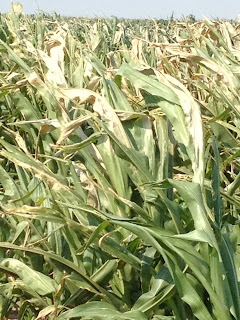
This corn is a good example. The growth stage the corn is at right now is very delicate. Many of our fields are starting to tassle. When the plant is approaching this stage, pollination and ear growth are greatly compromised if the plant is in any kind of stress. Currently our corn is stressed for water and then an additional stress for the extreme heat. You can see the burned tips on most of the leaves in this picture and that just shows you the damage that won't be overcome the rest of the summer.
This is a close up picture of some of the worst leaves. This is in a field of our irrigated corn. The heat damage is very evident in this picture. You can also see how curled the leaves are. On a normal year, the leaves should remain broad and bright green.
This is a shot that I took of some dryland corn in our area. The dryland corn is really struggling as you can tell. Dryland means that it is not supplemented with water from sprinklers. Dryland farmers rely on the rain that we receive to help the crops grow. We haven't received very much rain, if any in places, this summer. Before that, we experienced a very dry and mild winter. The damage this corn has endured through the heat wave will cause this field to be abandoned most likely. The one positive to this situation is that the ground is covered and the roots from the corn plants will keep it from blowing. Farmers in our area have battled blowing ground all year. When the topsoil gets to blowing, it jumpstarts the process of erosion. My dad wants to preserve the precious topsoil on his ground so that his son can farm it throughout his lifetime. This type of care and conservation of the land has been instilled in farmers for generations. It's the only chance they have at preserving their businesses and passing them on to the next family.
I hope to have a couple pictures up of our cotton fields soon. They look pretty good still. Cotton endures the heat a little better and takes less water. Plus, it's one of my favorite plants to watch grow!
Best,
Tera Rooney
Tuesday, July 3, 2012
Fourth of July Safety
This post has a double meaning: food safety and fire safety.
While we all know that July is in the heat (literally) of the summer and is the perfect time for grilling and fireworks, we need to be mindful of two points.
1. Remember to use a food thermometer when you're grilling. Sure, it's hot and you want to get the meat off the grill and onto your plate. But you could be in another kind of rush later on if you don't make sure that your foods have been cooked to proper temperatures to kill any bacteria that may exist. Here are the proper cooking temps for your 4th of July activities:
Ground beef/pork/lamb - safe and savory at 160 °F
Ground turkey/chicken - 165 °F
Steak - Medium - Rare 145 °F
Medium - 155 °F
Medium - Well 165 °F
Well Done 170 °F - I included this for reference sake, but it hurts to do so!
Poultry - Chicken & Turkey, Whole 180 °F
Breast Meat 170 °F
Thighs, Wings & Legs 180 °F
**Salmonella is killed at 165 °F
Pork - roasts, tenderloins and chops - 145 °F (no higher; nobody likes dry pork)!
2. Fireworks are awesome. I'm actually a pyromaniac and am one of the first people to buy fireworks on the day the stands open. But we're in a drought now and we all know that fire + dry pastures/hay fields = horrible fast-spreading disaster. If you are in a county with a burn ban in place, consider driving to a neighboring county and watching a sponsored fireworks show. I'm likely going to the Wamego, KS show (it's one of the best in the state). One night of fun shooting off bottle rockets and roman candles isn't worth the devastation of charred fields.
With these safety steps in mind - have a great holiday! And as always, remember the true reason for the season. We are a free country thanks to those who have gone before us and those who continue to fight for our freedoms.
Until next time,
~ Buzzard ~
Subscribe to:
Posts (Atom)


