Search This Blog

Friday, October 29, 2010

Cotton is King [Part 2]

This is part two on my posts about cotton.

Now that we know a little bit more about cotton as a crop and fiber product, let's talk about cotton as food. Cotton as food? Like cotton candy?

Well, after reading my last post, nobody really believes that cotton candy is the same stuff grown in the fields. Let alone, would you argue that cotton candy could actually be considered food!

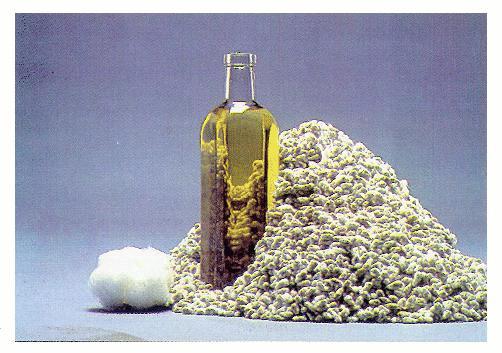
The cotton plant, besides producing a sustainable fiber because many alternatives to it require processing with non-renewable resources like petroleum, produces a seed. In fact, for every pound of fiber, 1.65 pounds of cottonseed is produced. Cottonseeds are very high in protein, energy, fiber, Vitamin E and phosphorus. The seeds also contain gossypol which is a toxin.

So with the abundance of cotton grown on the earth and a large population to feed, how can we use this crop to provide us with food for humans? Currently there aren't too many options, but work is being done to improve this.

The major way cotton makes its way to our dinner table is in MEAT. While noxious to humans, cottonseeds can be utilized in rations fed to large ruminant animals as they digest it through the four compartments of their stomach. Gossypol does pose a problem with infertility in bulls (intact, male bovine), but for the most part can be and is highly utilized to provide protein and energy in feed for cattle. Cottonseed hulls are also utilized as a roughage to mix in with the feed. So, just like corn is grown to be fed to livestock so that we can enjoy a good steak - cotton contributes to our pantry as well.


So, if the world produces around 44 million metric tons of cottonseed, there should be a way to produce a consumable product. This is the goal of many businesses in the cotton industry - to produce a major source of protein to feed people on a global basis. Biologists at Texas A&M University are doing just that by leading a research team that is mapping the entire cotton genome. By doing this, they have found a technology to remove the gossypol producing genes from the seed making it edible for humans and other livestock. The gossypol genes are important for the plant to express in the leaves and stems to fend off disease and pests, but if removed from the seed could be a phenomenal food source!


So phenomenal, in fact, the 44 million metric tons of cottonseed that we produce can be converted into 10 million metric tons of protein!

All in all, the work being done with cotton as a food source really first became public knowledge in 2006, and scientists believe it will take about a decade to develop edible cotton varieties for commercial use. That means in about 5 years this could be a reality. This is a testament to work being done in production agriculture to change processes our ancestors used to better accommodate a growing population.


Thursday, October 28, 2010

Educational System Screwed? Maybe not…

With all the budget cuts and bailouts that we deal with every day, one elementary school in Walton, Kansas has decided to go back to their roots with success. Walton 21st Century Rural Life Center has incorporated agriculture into every class in their curriculum. The K-5 grade school has had great results by outscoring other schools on state assessments.

The best thing about Walton incorporating agriculture in the school system is the integration of the town, students, parents, and teachers. Parents and other family members are involved with the classroom projects, field trips to farms, and even family-style cooking! Wouldn’t it have been great to have a home cooked meal every day for lunch when you went to school? In addition, with the world evolving more into a business world each and every day, providing the opportunity for children to spend more time around their parents can provide great opportunities for the students. Businesses have been in support of the school by offering discounts to the school in purchasing items.

Other schools need to take notice and look at the positive impact agriculture education can have on the students, and some are. The Oswego school district has been down to shadow and is replicating the system. There is no substitute for hands-on learning. I know several schools have considered eliminating their agriculture education system from their high school due to budget cuts. I would not be a first year veterinary student at Kansas State if it wasn’t for the fact of my agriculture education in high school.

Hopefully this trend will catch on and spread like wildfire. Maybe, just maybe, the education system is not screwed and there can be a light at the end of the tunnel. I applaud the efforts of Walton and now Oswego communities for implementing these programs and pulling together. The children are the future of our society. Upbringing kids in a way that will positively impact students by teaching them the “grass roots,” they will be able to expand their knowledge and become the next leaders.

Take care!

Miles Theurer

Tuesday, October 26, 2010

Cotton is King [Part 1]

This is part 1 of a 2 part post on Cotton as a crop, fiber product and food - Enjoy!

Back home, one of my favorite harvest seasons is underway. It's cotton picking season and the strippers are buzzing through the fields. To begin talking about Cotton, since it is a crop we might be less aware of, I thought it might be nice to explain how this crop gets from the farm to the consumer. Cotton is grown in 17 states and the U.S. is ranked third in world cotton production behind China and India. Texas begins harvesting cotton in late July and the season can go into late November in northern states.

This is what cotton looks like in a field when it is ready to be harvested. This is a field not far from my home near Satanta, KS.


Cotton is removed from the field by a machine called a cotton stripper. It is similar to the combines that harvest grains, but a little different. While the invention of the cotton stripper highly improved the process from the old days of picking cotton by hand, unfortunately for cotton producers, a cotton stripper also harvests a lot of foreign material too. Foreign material can consist of burs, sticks, fine leaf trash and soil particles. The more foreign material contained in the stripped cotton the more grade reduction and price loss at the gin.

This is a cotton stripper, running along side it is a boll buggy being pulled by a standard tractor.

Each little white ball you see in the field is referred to as a boll. Cotton is transferred from the stripper to the boll buggy. The boll buggy carries the millions of little cotton bolls to the edge of the field. The picture below depicts a boll buggy emptying into a module builder. The module builder sits at the edge of the field out of the way for the cotton stripper to continue stripping.

After the cotton is transferred into the module builder, it is compacted into a large module. Modules are formed to protect the cotton and as a way of storing the cotton until the gin is ready. One module is usually about 13-15 bales of cotton. One bale of cotton weighs around 500 pounds. In the last couple of years total US acres have averaged .6 bales per acre of cotton planted overall. My dad always hopes for "2-bale cotton" which means his goal is to harvest 2 bales per acre or 1000 pounds per acre. The picture below shows several modules of cotton sitting on the edge of a harvested field. The green tarps on top serve as protection from any rain or weather elements that the cotton might be subjected to. Large numbers are painted on the side of each module for identification, and when the gin is ready to take more modules in, a truck will come and pick up the modules and transport them one by one to the gin.

While producers in Kansas used to have to send their cotton to other states to be ginned, in the last decade a few gins have popped up in the southern part of the state. My family is fortunate to be a member of the Northwest Cotton Grower's Co-Op Gin. It is located near Moscow, KS which is a hop, skip and a jump away from my home town. We are in the Southwest portion of Kansas, but it is the Northwest area of typical cotton growing states.. When the gin was built it made cotton a more profitable crop for our area farmers because it greatly reduced the transportation costs involved with shipping modules south to Texas for ginning. Cotton is also profitable in our area because it requires a lot less irrigation than corn or milo and you can grow it in soil that isn't as superior.

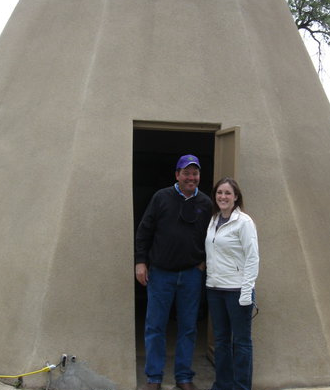
If you would like more information on Cotton in the U.S. the best website to refer to is the National Cotton Council of America. I got a lot of my information off of their website and also from my dad. He is a third generation farmer and a second generation cotton grower. His farm is currently harvesting the cotton crop and they are pretty excited because cotton prices are good right now. Here is a picture of my dad and I in my home town, Satanta.


Stay tuned for Part 2 of Cotton is King. Cotton is normally thought of as a fiber product, and a darn good one at that! One bale of cotton can produce 1,217 men's t-shirts! The upcoming post will be more about how cotton can be and is utilized as a food product.

Friday, October 22, 2010

Behind the Bloggers: Dr. Dan Thomson

This is a bit of a different “Behind the Bloggers” post, but I figured it was time to expose Dr. Dan! This is the man behind our Food For Thought group. He is our advisor and mentor. He dedicates his time to promoting a positive face for the agriculture industry and inspires our group to do the same.

Dr. Daniel Thomson is a Jones Professor of Production Medicine and Epidemiology at Kansas State University College of Veterinary Medicine and the director of the Beef Cattle Institute. He received his bachelors at Iowa State University, a masters at South Dakota State University, a Ph.D at Texas Tech University and a DVM at Iowa State University. He is lucky enough to call Kansas home now! At KSU he has both teaching and research assignments.

He spends his time representing the U.S. cattle industry through positive and proactive initiatives to improve animal health and welfare. We are honored to have his guidance and resources as our advisor in Food For Thought, and he is truly the driving force behind our bloggers! Someday it is my goal to convince him to write a blog post.

Hold me to it,

Tera


Here is a picture of Dr. Thomson while in Paris, France, where he chaired the OIE Beef Cattle Production and Animal Welfare committee.

Tuesday, October 19, 2010

Behind The Blogger: Hyatt Frobose


Good Afternoon!
My name is Hyatt Frobose and I am a new blogger for Food For Thought. I am a 23-year old graduate student in Swine Nutrition and the Assistant Livestock Judging Coach at Kansas State University. I'm excited to get my first post on the blog although I must admit I am far from experienced in the art of blogging.


A little more about myself: I grew up in the town of Pemberville in northwest Ohio where my family had a small cow/calf and feedlot operation as well as a couple hundred acres of corn, wheat and soybeans. My dad works as an agricultural extension agent for Ohio State University and my mother is a veterinarian working with both livestock and small animals. As they both held off-farm jobs, we spent most of our evenings taking care of the livestock or crops. Being immersed in agriculture as a young boy inspired me to get involved in youth activities like 4-H and FFA and ultimately to pursue my degree in animal science.


Hailing from a state with a much larger population than Kansas, I feel like I bring a different perspective to the table, as a passionate agriculturalist I can still put myself in the position of the urban consumer and understand their side of the coin. I am a proud livestock producer and an avid consumer of the stock I raise (ask my fiance, Brandi Buzzard, as she has to eat all the pork and beef I cook).


I want to voice my support to everyone in agriculture nationwide for mobilizing and making our voices heard by consumers everywhere. Although I know that there is alot of consumer distrust with farmers and ranchers today, to me it is more from a lack of accurate information or misrepresentation by special interest groups like the Humane Society of the United States and the People for the Ethical Treatment of Animals.


As a consumer viewing this blog, I commend you for taking the time to learn more about those who proudly produce the food on your family's plate. I think some of you may laugh at the image below, but this was posted in an actual newspaper and it demonstrates how far some people are removed from the food they eat.


Until next time,
Hyatt

Monday, October 18, 2010

Foodie Feature: Soul Feeding Farmers


When I came across a news release that announced the non-profit status of a grassroots organization of young people with a passion for all things Ag, I wanted to send my applause all the way to California! Alexis, Salvador, Steve, Taylor and Joe were frustrated with our generation's lackluster views on where our food comes from. They aim to educated and excite people of the millennial generation. We have an abundance of choices available to us at the grocery store and this group wants us to become more aware and appreciative of that fact.

I Love Farmers They Feed My Soul are known for their aggressive approach to advocacy in social media networks. They have officially become a non-profit organization complete with a board of directors. I love that they are "rocking" the industry with an eccentric and youthful approach rather than the aged conservative appearance our industry usually receives.

Browse their website.

Follow their blog.

Retweet their tweets.

Like their facebook page.

Because they are doing a great job of promoting the farmers and ranchers who are work hard to feed our country...and our souls!

Friday, October 15, 2010

Football and Food

If you missed last night's game K-State beat KU 59-7 in the sunflower state showdown and I can't hide my excitement. So, I decided not to fight it and instead talk about tying my passion for agriculture to my love for K-State. For example, this is my favorite T-shirt, which I happen to be wearing at a K-State football tailgate earlier this year.


K-State's Collegiate Cattlewomen sell the "I heart Beef" shirts for $10 a piece. Proceeds go to CCW activities and beef promotions. You can order one yourself by emailing CCW President Callie Jo Williams at calliejw@ksu.edu.

CCW also sells these "Eat Beef" license plates.


You can learn more about ordering plates here.

Finally, I'm going to share a picture of some K-State students at a previous K-State/KU football game.


Now I'm not advocating for making fun of people's weight, but I would like you to remember wherever you go and whatever you do, your activities are fueled by food provided by farmers and ranchers.

Food is a big part of football for most fans - whether it be your signature dip or something special on the grill. So whatever your team of choice, take a chance before your next game to stop and think about where the pre-game burgers, beer, chips and salsa came from and thank the food producers who help fuel your life.

Best,
Chelsea

LinkWithin

Related Posts with Thumbnails